

OTTAWA — Canada's military reopened a formal channel to China's People's Liberation Army last Friday for the first time in eight years, and Canadians have learned of it only from Beijing.
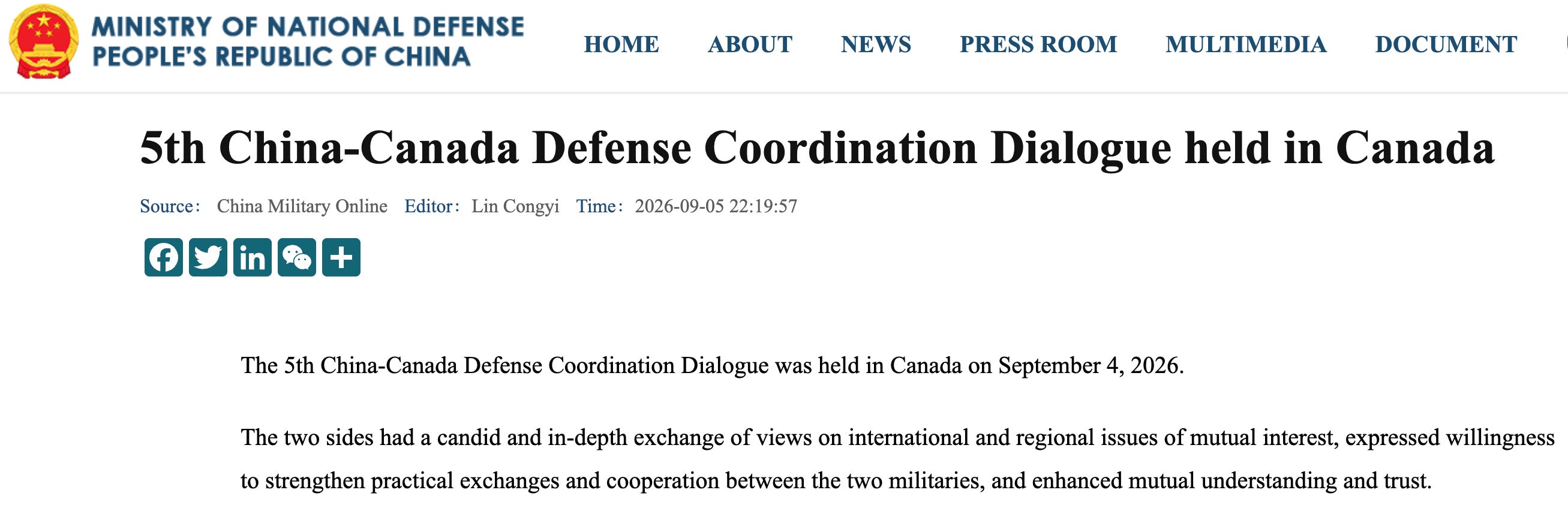
China’s defence ministry says Canada and China revived their formal Defence Coordination Dialogue on September 4.
Canadians have learned of the meeting not from their own government, but from a terse statement issued by Beijing.
The fifth China-Canada Defence Coordination Dialogue was held in Canada, according to a two-paragraph notice posted at 10:19 p.m. Beijing time on September 5 on the English-language website of the Ministry of National Defense of the People’s Republic of China.
The ministry said the two sides discussed international and regional issues and expressed a willingness to strengthen “practical exchanges and cooperation” between their militaries.
Mark Carney did not campaign on reviving this mechanism.
Asked at the April 17, 2025, federal leaders’ debate to name the biggest security threat to Canada, he said: “I think the biggest security threat to Canada is China.” The platform he ran on mentioned China once, in a line about preparing to face a hostile Russia or an emboldened China. It proposed no resumption of defence dialogue with Beijing.
Among the senior PLA officers in Canada last week was Gen. Yang Zhibin, commander of the People’s Liberation Army’s Eastern Theater Command.
The Eastern Theater Command is the command China’s own state media credits with major joint drills around Taiwan, including the “Justice Mission 2025” exercise announced by Xinhua last December. Adm. John Aquilino, then head of United States Indo-Pacific Command, testified to the House Armed Services Committee in 2024 that “all indications” pointed to the People’s Liberation Army meeting Xi Jinping’s directive to be ready to invade Taiwan by 2027.
The 2026 Annual Threat Assessment of the United States intelligence community is more measured, finding that Chinese leaders do not currently plan to execute an invasion of Taiwan in 2027 and have no fixed timeline. Either way, Yang leads the theatre command the Pentagon describes as responsible for operations against Taiwan, and last week he was in British Columbia.
Days before the Victoria conference opened, Carney was describing a different relationship in different terms.
Trade talks with the Trump administration had collapsed.
Whether the U.S. or Canadian side is more to blame for that rupture is very hard to determine, among competing politicized narratives and Carney’s refusal to release the trade deal that was tabled, despite Opposition leader Pierre Poilievre’s calls to do so.
“You’re at war when you get attacked,” the prime minister said on August 22. “We got attacked.”
The specific Defence Coordination Dialogue between Ottawa and Beijing had been dormant since April 10, 2018.
The Department of National Defence’s own disclosure to a parliamentary committee lists all four previous rounds — November 28, 2013; September 23, 2014; November 28, 2016; and April 10, 2018 — and states that the last bilateral military training between the Canadian Armed Forces and China took place in 2018.
Canadians had few details about how that relationship worked from their government the last time either.
After Canada arrested Meng Wanzhou in December 2018 and Beijing seized Michael Kovrig and Michael Spavor, Chief of the Defence Staff Gen. Jonathan Vance cancelled a planned invitation for PLA personnel to observe winter-survival training at CFB Petawawa in 2019.
Few Canadians knew that PLA personnel had already observed Canadian winter-survival training at Petawawa in February 2018.
The record surfaced two years later, when 34 pages released under access to information came back with the sensitive passages greyed out instead of blacked out, leaving them legible.
Rebel News published them on December 9, 2020. One American concern recorded in the files was “unintended and undesired knowledge transfer to the PLA.”
Global Affairs Canada had objected to the post “Two Michaels” case cancellation, warning it would be read in Beijing as retaliation over Meng. A draft letter from Justin Trudeau’s deputy minister Ian Shugart to his counterpart at National Defence said the military should consult Global Affairs in future before taking any action that could affect Canada-China relations.
The day after publication, Justin Trudeau’s government confirmed to the Toronto Sun that a People’s Liberation Army delegation had come to Canada in February 2018.
National Defence later put it in writing.
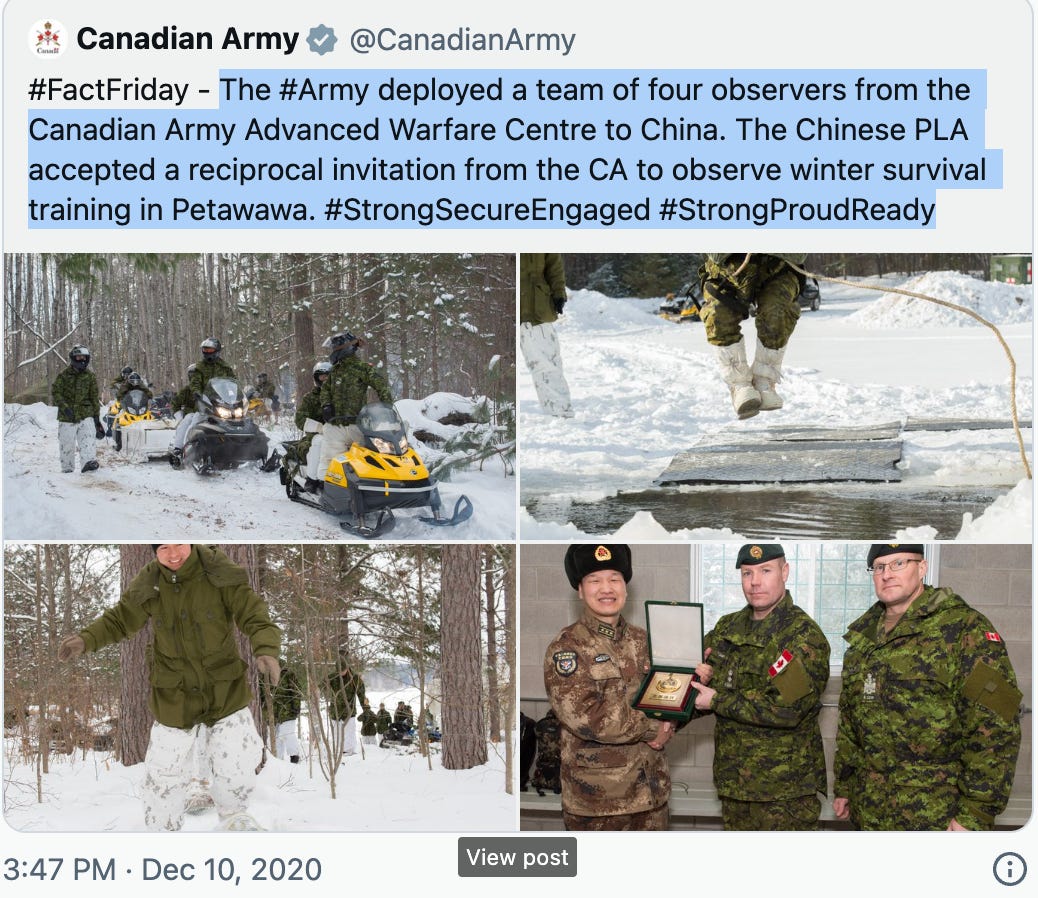
The Canadian Army posted: “The #Army deployed a team of four observers from the Canadian Army Advanced Warfare Centre to China. The Chinese PLA accepted a reciprocal invitation from the CA to observe winter survival training in Petawawa. #StrongSecureEngaged #StrongProudReady.”
The fuller record of Ottawa’s internal dispute emerged only two years later, through the access-to-information release.
The framework governing those engagements is the Cooperation Plan Initiative, a non-binding arrangement signed in 2013 by the Canadian and Chinese defence ministers, whose stated scope includes the Defence Coordination Dialogue.
On December 10, 2020, Defence Minister Harjit Sajjan told the House of Commons that the agreement was one reason Canada had “changed our approach,” adding that the concerns raised about China were why Canada had stopped the training.
China says the September 4, 2026 meeting was the fifth dialogue held under that framework.
The South China Morning Post reported the renewed dialogue on September 5, and the state-run China Daily followed on September 7 under the headline “China and Canada resume military talks after eight years.”
As of 10 a.m. EDT on September 7, The Bureau could find no Canadian newsroom report about the distinct September 4 bilateral dialogue and no Canadian government readout acknowledging it.
A Department of National Defence briefing package made public in June 2026 said Canada would work toward “greater dialogue with China.”
Setting out the terms of a warming relationship with Beijing on December 20, 2025, Mark Carney said: “There are areas, artificial intelligence, critical minerals, defence, where clearly the security threats are such that we would not have a deep relationship with China in those areas.”
In April, The Bureau published a close reading of the speech Carney delivered in Beijing on January 16, in which he defined the new strategic partnership across “five areas where we can make significant immediate gains”: “energy and climate competitiveness, trade particularly in agriculture and food, multilateralism, security and public safety, and deepening people-to-people ties.” Our concern then was that a partnership sold to Canadians as a canola and electric-vehicle arrangement had a structure reaching much further — into security, public safety and the shaping of multilateral institutions.
Defence was not among the five.
There is a defensible case for keeping a line open to an adversary’s military. But as with the Carney government’s secret MOU partnering the RCMP and Beijing’s Ministry of Public Security, the same entity tied to an illegal CCP police station prosecution in New York City, Canadians have no warning, and no clarity, on what this new dialogue between Canada’s and Beijing’s militaries will entail, and what guardrails, if any, will be in place.
More Liberal TDS lunacy. The United States will not tolerate Chinese military presence in Canada, right on the US main land border.
Canada has ceased to be a viable independent country.
Wow since Carney becoming Prime Minister we’ve been supercharged towards Chinada! How can Canadian media not report on this? Oh right I guess it’s known as “state media” for a reason.