Canada Bars a Senior Chinese Police Officer Over Crimes Against Humanity — as Carney Deepens Ties With the Same Security Apparatus

OTTAWA — A senior officer of China’s Public Security Bureau who spent more than three decades supervising interrogations and detentions in Hebei Province has been barred from Canadian permanent residency — along with his wife and child — after a federal immigration officer found reasonable grounds to believe he was complicit in the systematic torture of criminal suspects.
Justice Shirzad Ahmed upheld that finding on judicial review, in a ruling that carries indirect ramifications for Prime Minister Mark Carney’s controversial decision to deepen cooperation with Chinese police.
Carney’s government signed the memorandum of understanding with the Ministry of Public Security — the same national apparatus that oversees the provincial bureaus whose conduct the court condemned — without releasing the agreement’s text or explaining what protections exist for diaspora communities. As The Bureau has reported, critics from Hong Kong diaspora organizations have raised “deep fear and anxiety” over the deal.
The Chinese officer, referred to in the ruling only as the spouse of applicant Li Li, built a 30-year career inside the Shijiazhuang Municipal Public Security Bureau in Hebei Province, rising from criminal brigade investigator to vice director of one of its branches in 2013.
At the time his wife applied for permanent residency in August 2016, he held the rank of Police Supervisory Class 1 — a senior designation the court noted reflected not merely years of service but experience in his investigative role.
He supervised between 120 and 150 personnel and oversaw investigations, interrogations, and detentions throughout his career.
The officer maintained, in letters submitted to Immigration, Refugees and Citizenship Canada, that he had never witnessed or participated in the abuse of suspects, and that his role was to ensure interrogations in Hebei were conducted according to the law.
Canada’s immigration officer wasn’t persuaded.
The ruling appears to add weight to systemic concerns already documented in The Bureau’s reporting, including classified Canadian Security Intelligence Service warnings that Ministry of Public Security officers have run covert and unauthorized operations on Canadian soil, including surveillance of diaspora members, coercion of family members in China, and payments to Chinese-language journalists in Canada to locate and track targets.
Those warnings are consistent with a body of international documentation stretching back decades.
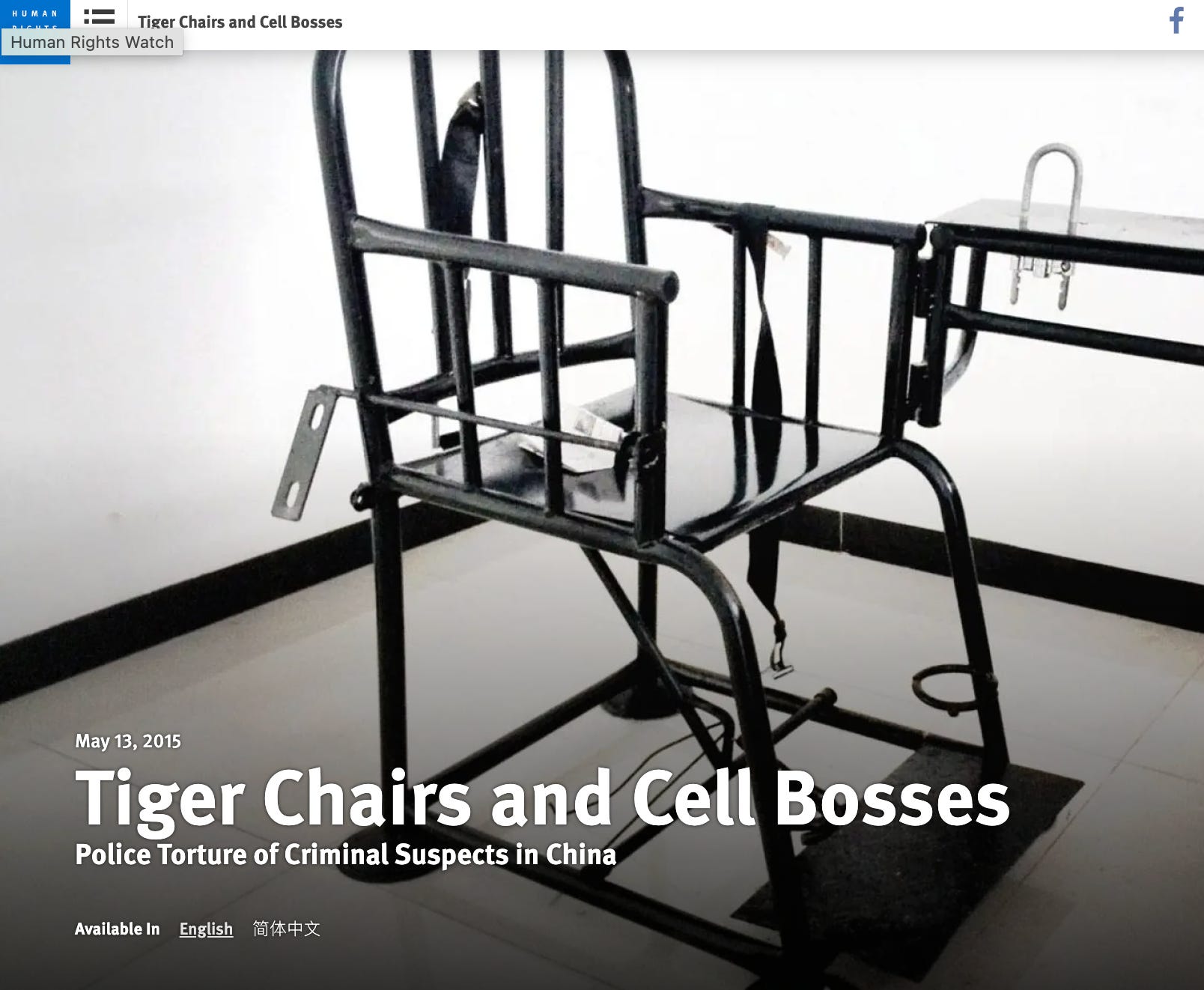
A landmark 2015 Human Rights Watch report found that physical and psychological abuse during Public Security Bureau interrogations was pervasive — so much so that even Chinese officials had characterized torture in custody as "common," "serious," and "nationwide."
Former detainees described being hung by the wrists, beaten with batons, and subjected to prolonged sleep deprivation; some were held for days in tiger chairs designed to immobilize suspects, or bound in handcuffs and leg irons. One prisoner awaiting review of a death sentence had been handcuffed and shackled continuously for eight years. An analysis of 432 court verdicts found that judges rarely investigated torture allegations in any meaningful way.
The U.S. State Department's most recent human rights assessment independently corroborated the pattern, citing credible reports of torture, arbitrary detention, and transnational repression as among China's significant and ongoing violations.
It was against that documented institutional backdrop that Canada’s immigration officer assessed the career of the Hebei officer — and found it damning.
Drawing on reports from international non-governmental organizations, academic literature, and contemporaneous statements from the Chinese government itself, the officer concluded that torture during interrogations and detentions was systematic and policy-driven within the Public Security Bureau — not merely in pockets of the country, but nationwide, and specifically documented in Hebei Province.
The officer found that a man of the applicant’s rank, with supervisory responsibilities spanning more than three decades in the criminal investigation division, would have been aware of human rights violations committed by colleagues and subordinates.
No specific instance of torture was attributed to the applicant’s spouse personally.
Justice Ahmed dismissed Li Li’s application for judicial review and upheld every element of that reasoning. The court found the immigration officer’s reliance on country condition evidence was proper, that criminal suspects in custody constitute a recognized civilian population under international criminal law, and that systematic torture conducted pursuant to a policy satisfies the legal threshold for crimes against humanity. The judge rejected the applicant’s argument that detainees — because their status is transient rather than fixed by ethnicity or religion — cannot be considered a distinctive civilian population for the purposes of the legal test.
“Those who commit atrocities against groups of civilians who share transient identities cannot escape condemnation,” Justice Ahmed wrote.
Because Li Li’s accompanying spouse was found inadmissible under the Immigration and Refugee Protection Act, she and their child are inadmissible as well. The application for permanent residency was refused.


High five to the judge! It’s about time we hear a decision such as this.
Its a start, only about 1 million more to go. This country has let the worst of the worst in. Good luck getting them out of here.