


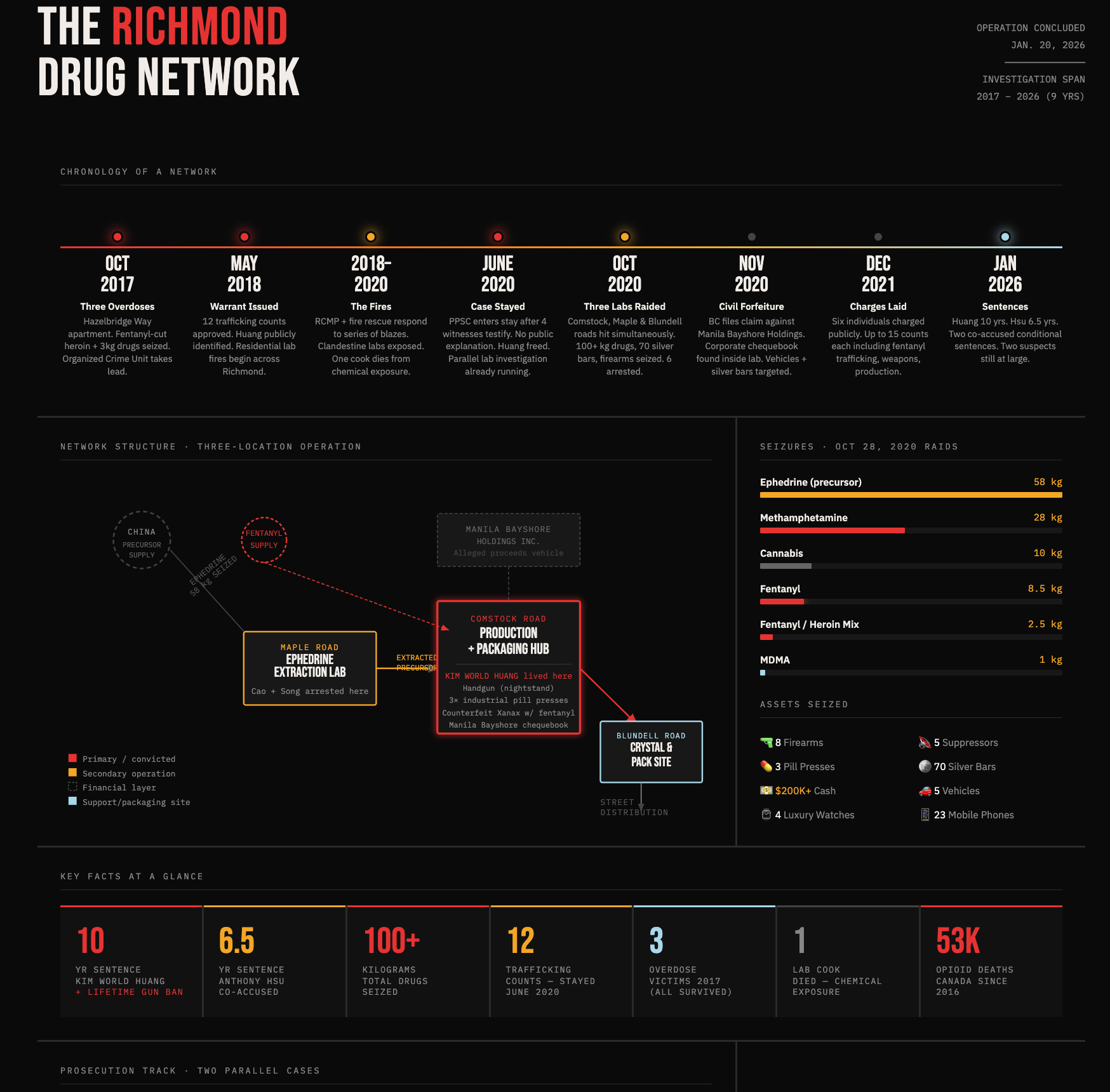
RICHMOND, B.C. — On a Tuesday morning in October 2017, paramedics arrived at an apartment complex on Hazelbridge Way, in the heart of Richmond, to find three people unconscious from drug overdoses. When police searched the unit, they found a pharmacopeia of the modern overdose crisis: fentanyl cut into heroin, cocaine, methamphetamine, MDMA, ketamine. The three victims were revived. It was the kind of scene that had become numbingly routine across British Columbia, a province then in the second year of an exponentially spiking overdose crisis. By 2017, fentanyl was present in 81 percent of overdose deaths.
What was less routine was the Chinese organized crime network that Richmond’s investigators would chase for the next nine years — from residential fires to an industrial drug lab where a chemist died from chemical exposure, to sophisticated transnational money laundering, the seizure of 70 silver bars, large weapons caches, and industrial pill-pressing and high-end lab equipment.
In that first fentanyl overdose case, after what police described as a “comprehensive and exhaustive investigation,” Canada’s federal prosecution service approved 12 counts of possession for the purpose of trafficking against a 30-year-old Richmond resident named Kim “World” Huang. In May 2018, Richmond RCMP announced the warrant for his arrest, specifically noting the heroin cut with fentanyl — 164 grams of it — among the more than three kilograms of drugs found on scene.
“We are fortunate to have secured these drugs,” said Cpl. Dennis Hwang. “Other lives will have been saved.”
What followed over the next eight years tells a complicated story about the limits of Canada’s ability to prosecute its highest-level fentanyl networks — and about the architecture of a transnational drug production system that is running at industrial scale inside residential homes in some of Canada’s most affluent suburbs.
The trial began June 8, 2020, in B.C. Supreme Court in Vancouver, before Justice Warren Milman. The federal Crown called four witnesses on a preliminary evidentiary hearing. Three days later, after hearing police witnesses testify, the Crown entered a stay of proceedings.
The Crown provided an answer that only raises questions: “After hearing the testimony of Crown’s witnesses, the Crown re-assessed the case and determined that the reasonable prospect of conviction no longer existed.”
No further detail was provided. The Crown has not publicly explained what those witnesses said, what evidence failed, or how a case built on three overdose victims, kilos of fentanyl-laced heroin, and a “comprehensive and exhaustive investigation” by the Organized Crime Unit could collapse on day four of a closed trial.
Was a witness threatened, or an informant exposed in disclosure to defence lawyers? That is what happened in late 2018 in another major drug trafficking and money laundering investigation called E-Pirate — targeting the same overlapping Chinese transnational crime networks in Richmond, which centred on an underground banking and casino money laundering hub responsible for billions in money laundering in British Columbia, moving drug money from Vancouver and Mexico and Peru back to Chinese fentanyl precursor factories.
Regardless, in this high-consequence fentanyl overdose case, Kim “World” Huang walked out of court free.
It was not Huang’s first encounter with the justice system. In early 2017 — months before the three overdose victims were found on Hazelbridge Way — he had been convicted in Vancouver on a drug smuggling offence and served 90 days in jail. The sentence did not deter him. Within months of his release, he was implicated in the October 2017 fentanyl case.
This outcome, while specific to one defendant, fits a pattern that has alarmed law enforcement officials across Canada for years. Most recently, as The Bureau reported in July 2025, Canadian federal prosecutors quietly dropped charges brought by the same Richmond RCMP anti-drug units against a Chinese scientist in Vancouver — referred to only as “Dr. X” — who was accused of importing more than 100 kilograms of PMK ethyl glycidate, a designer MDMA precursor engineered to slip past international chemical controls. The same federal prosecution service stayed those charges on March 31, 2025, with a statement word-for-word identical to the one it issued when it freed Huang five years earlier: the standard for prosecution, it said, “was no longer met.” No further explanation was provided in either case.
Dr. X, The Bureau reported, had documented affiliations with Zhejiang University — flagged by Australian intelligence analysts for links to China’s Ministry of State Security — and was reportedly working in Canada under Beijing’s “Talents” plan, a recruitment initiative U.S. intelligence has described as a platform for espionage and dual-use technology transfer. The Bureau has since learned that the scientist is a woman involved in United Front community groups connected to the Vancouver consulate, and has appeared in the campaign materials of a Canadian political candidate, according to photographic evidence.
Meanwhile, the original fentanyl case against Kim World Huang was also stayed — and the RCMP quietly turned its attention to different chemicals and other properties.
The Fires
Starting in 2018, Richmond homes had been burning down with a peculiar regularity. When firefighters got inside, they found drug lab equipment. The fires appeared to be, in retrospect, the hazard signature of the hypophosphorous reduction method — a particularly dangerous way to synthesize methamphetamine from ephedrine that significantly increases fire risk. Richmond RCMP concluded the labs were connected to a single organized group based in the city. By June 2020 — the same month the Kim “World” Huang fentanyl trafficking case was stayed — investigators had already opened a parallel investigation.
