

VANCOUVER — British Columbia’s civil forfeiture director has moved to seize two Lower Mainland homes from Ravinder Singh Dhanda, the Vancouver-area long-haul trucking broker charged in Los Angeles with running an industrial cocaine and methamphetamine pipeline from California into Canada — the second Operation Hard Ball forfeiture action the province filed last week, a fresh sign that the director is racing the American prosecutions into British Columbia’s own courts.
The notice of civil claim, filed July 10 in B.C. Supreme Court, targets a White Rock property on Cliff Avenue and a Surrey property on 36A Avenue, both held by Dhanda and his wife, Manjit Kaur Dhanda, as joint tenants. It lands two days after the director’s parallel action against Garinder Singh Deo, the West Vancouver alleged gangster arrested in France on an American warrant, and it draws on the same investigative spine: a criminal probe the RCMP’s Federal Policing Pacific Region opened in coordination with the FBI in 2023, “involving organized criminal activity, international drug trafficking, extortion, racketeering and violence,” connecting three India-based transnational crime groups. Dhanda, the claim states, was a target of that investigation, was indicted in the United States as a result, and was arrested in British Columbia.
The indictment underlying the claim is the one The Bureau examined in detail last week — the eight-count filing that reads as the industrial blueprint of the Mexico-to-Canada corridor.
Its manner-and-means section alleges that Dhanda operated a brokerage providing international smuggling services to drug trafficking organizations in the United States, Canada, and Mexico, moving hundreds of kilograms of cocaine and methamphetamine each week: Mexican cartel couriers delivering cocaine in Los Angeles parking lots, identities verified by the matched serial numbers of torn dollar bills; the drugs held at stash sites across greater Los Angeles; loads concealed aboard long-haul semi-trucks carrying legitimate goods, and, at the frontier, hidden aboard farm trucks working the borderland itself.
The indictment’s most damning allegation for Canadian institutions is that one of Dhanda’s alleged associates, Gurtej Singh Smagh of Creston, gathered the Canada Border Services Agency’s inspection schedules from an individual working inside the agency — Canada’s border, on the sworn account of an American grand jury, sold. And in a South Surrey meeting with an undercover informant in January 2025, Dhanda allegedly announced he intended to start a new “cartel.”
Smagh's home base tells its own story.
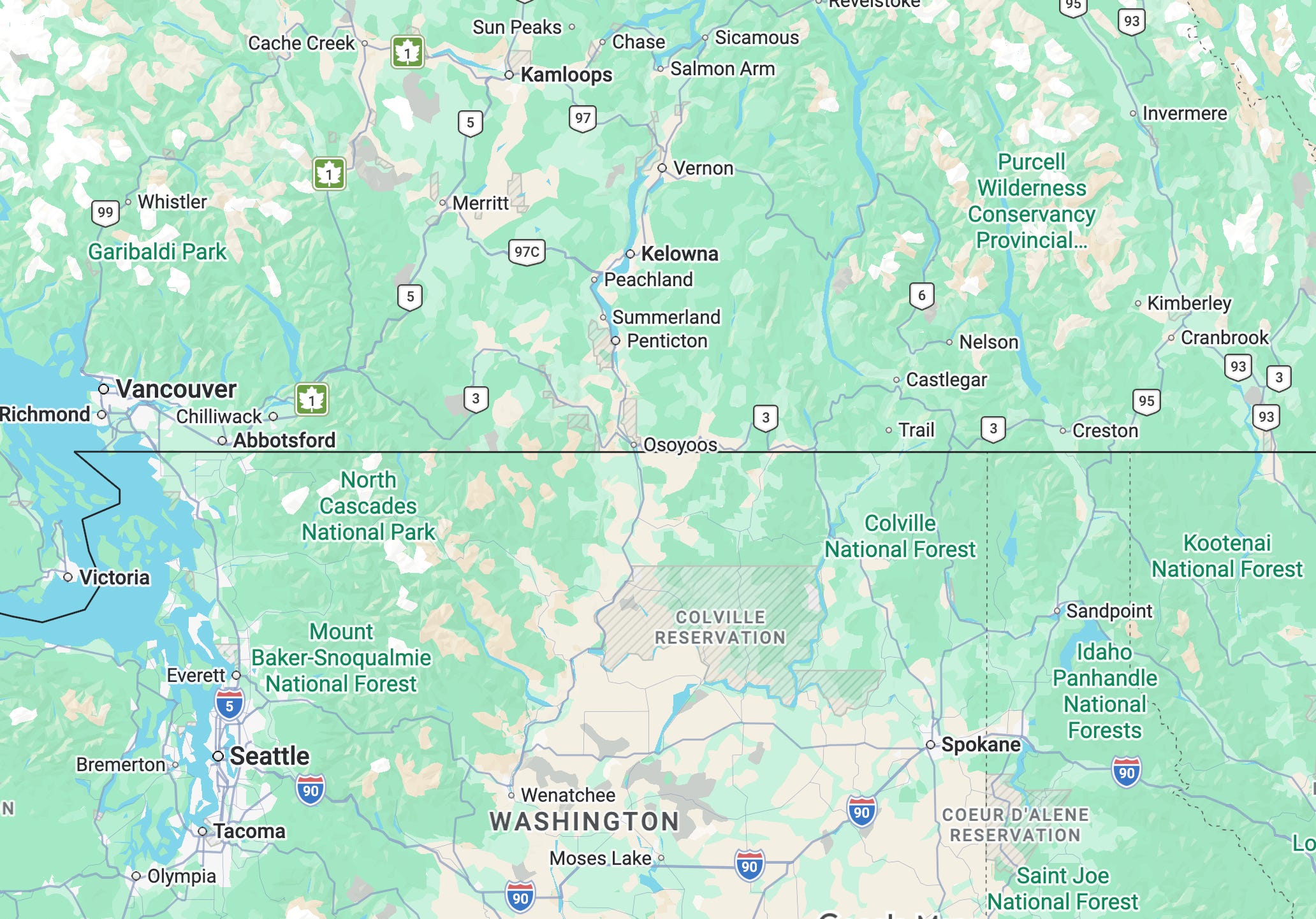
Creston is a Kootenay mountain farming community of some 5,500 people, set in a river valley about 20 miles north of the Idaho line, where the Rykerts border crossing feeds onto U.S. Route 95 — the two-lane highway that runs south through Bonners Ferry and Sandpoint to Coeur d'Alene, and from there, by way of Interstate 90, west into Spokane.
It is precisely the kind of rural corridor, far from the commercial congestion of the Pacific Highway truck crossing at Surrey, that the indictment describes the network exploiting.
An hour west, across the Kootenay divide, lies Nelson — the mountain town where, seventeen years before Smagh's charges, a twenty-four-year-old mountain biker and helicopter pilot named Samuel Lindsay-Brown ran BC Bud into Washington State before the DEA arrested him unloading a load in the Colville National Forest, and where, four days later, he was found hanging in a Spokane jail cell.
Where the American indictment charts the drugs, the forfeiture claim charts the money.