


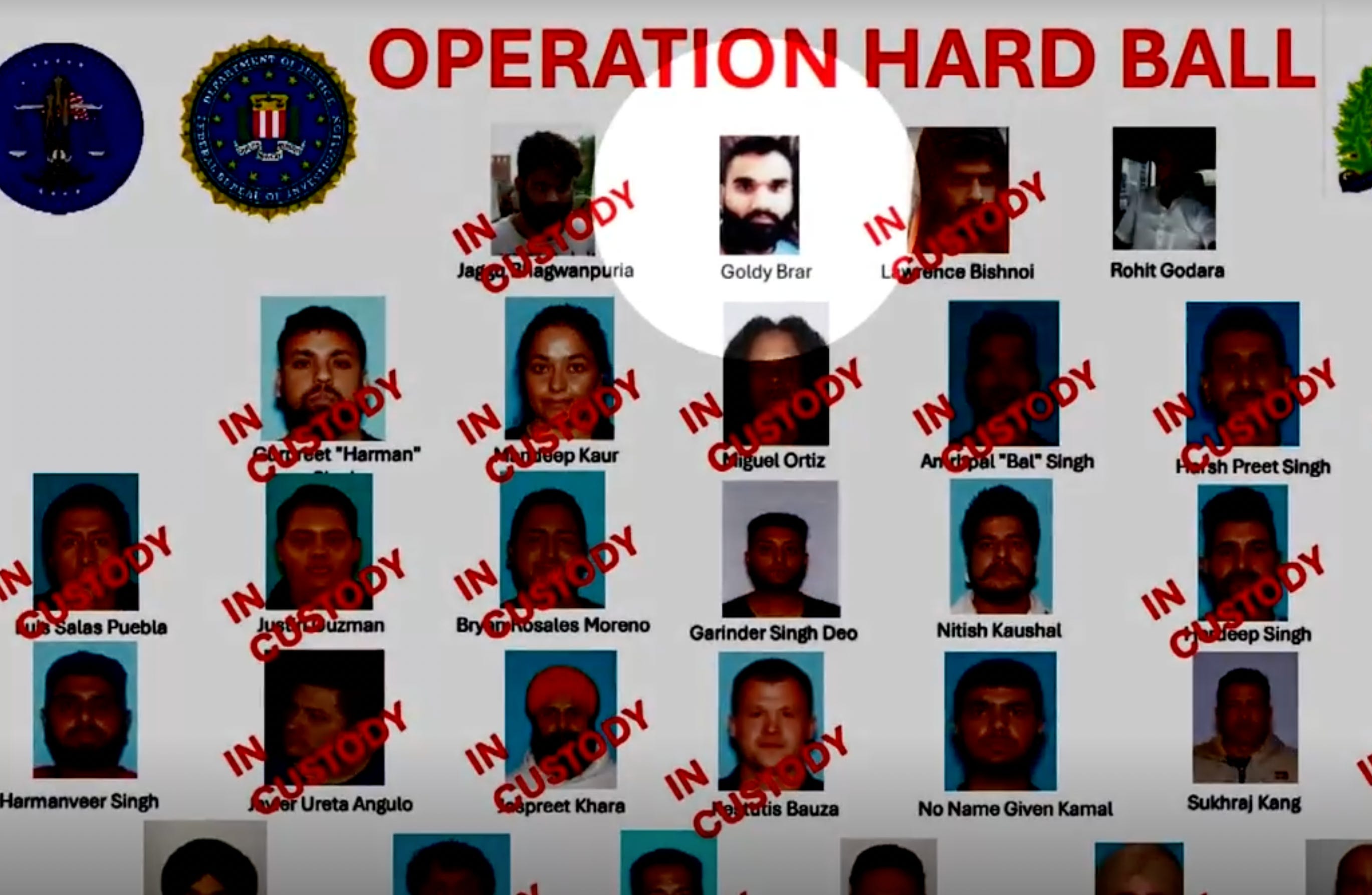
VANCOUVER – British Columbia’s civil forfeiture director has moved to seize more than $11 million in Vancouver-area real estate from Garinder Singh Deo, a longtime Lower Mainland gangster charged in the United States with facilitating an India-based transnational crime syndicate — in a claim built on years of suspicious transaction reports filed by Canadian banks to Fintrac, and on a parallel RCMP investigation that shadowed the FBI’s Operation Hard Ball.
Deo is charged in California with aiding the India-based Bhagwanpuria gang, according to U.S. indictments, by purchasing bulk quantities of cocaine and heroin that were to be shipped from Southern California to the eastern United States. The RCMP said Deo was arrested in France on July 7, the day after the Los Angeles announcement, and is in custody there awaiting extradition to the United States.
In a rare feature of a British Columbia forfeiture pleading, the director’s notice of civil claim — filed July 8 in B.C. Supreme Court — cites the United States Racketeer Influenced and Corrupt Organizations Act, the Hobbs Act and the U.S. Controlled Substances Act as the unlawful activity underpinning the seizure of Canadian homes. The province, in other words, appears to be reaching for American criminal statutes to strip assets on Canadian soil — a legal architecture that reflects the underlying reality of the case and a pattern documented in The Bureau‘s extensive reporting on the Ryan Wedding case.
The investigation that exposed Deo’s alleged role was led by American prosecutors, in a pattern The Bureau has documented across the most significant transnational organized crime cases touching Canada, where disclosure burdens flowing from the Supreme Court’s Stinchcombe ruling and the absence of any Canadian equivalent to the RICO statute have left it to United States grand juries to charge what Canadian courts do not.
The claim also pleads terrorism financing offenses under Canada’s Criminal Code — allegations that Deo was “enriching international criminal organizations and terrorist groups” — language that lands in a new legal environment. Canada designated the Bishnoi enterprise, the lead syndicate charged in Operation Hard Ball, as a terrorist entity in September 2025, and Ottawa has moved under sustained pressure from the Trump administration to designate Latin American cartels as terrorist organizations, opening terror-financing liability for those who service the trafficking economy.
Deo, 40, was named in a federal indictment unsealed in Los Angeles alleging that, though not charged as a member of the Bhagwanpuria organization — a syndicate of more than 1,000 members worldwide engaged in murder-for-hire, drug trafficking, kidnappings, extortions and weapons trafficking — he helped enrich it by purchasing bulk quantities of cocaine and heroin to be shipped from Southern California to the eastern United States, including an attempted June 2025 shipment of 99.2 kilograms of cocaine and one kilogram of heroin intercepted by law enforcement.
Vancouver Sun reporter Kim Bolan has reported that Deo is a Wolfpack gang associate — the Canadian alliance of Hells Angels, Red Scorpions and Independent Soldiers figures and Iranian-linked criminals that police have confirmed distributed cocaine in Canada for the Sinaloa Cartel.
Police raided his West Vancouver home the day of the Los Angeles announcement; the RCMP has since confirmed he was arrested in France the following day.
The forfeiture claim itself states that Deo “was arrested as a result of the Investigation.”
What the pleading maps, in granular land-registry detail, is the machinery The Bureau has spent years documenting and that Wilful Blindness traced through the casino and real estate economies of British Columbia: the conversion of transnational crime proceeds into Vancouver-area property through numbered companies, family nominees and short-term private lending — the province’s housing market operating as a laundering platform and, in the government’s own pleaded words, an instrument of unlawful activity.
According to the claim, Deo “did not have sufficient lawful employment, income, and/or legitimate business income to acquire, finance, improve, maintain, or preserve” any of the three properties targeted.
Instead, the director alleges, he used corporate entities and family members to hold them. His company, 1163658 B.C. Ltd., of which he is president and sole director, bought the West Vancouver house at 2030 Westdean Crescent in October 2020 for a stated $2.8 million; after substantial demolition and renovation work between 2023 and 2025 — financed through short-term private mortgages from VWR Capital Corp. and a syndicate including the Lohn Foundation, with Deo as covenantor — the property now carries a 2026 assessed value of $5,543,000.
The allegations are unproven, and no legal response has yet been filed.
GSMD Enterprises Ltd., whose president and sole director is Deo’s wife, Aleksandra Ponomareva — but in which the claim alleges Deo “retains a beneficial and controlling interest” — bought a Surrey property at 16087 59 Avenue in November 2023, assessed at $2,646,000. And in May 2023, Deo, his sister Harinder Kaur Deo and his brother-in-law Lakhbir Singh Gill took joint title to a third property at 12645 26A Avenue in Surrey for $1,950,000, financed through Toronto-Dominion Bank mortgages; it is now assessed at $2,852,000. The claim states the director is not aware of any participation or knowledge of unlawful activity by TD Bank or Vancouver City Savings Credit Union.
On or about June 19, 2026 — less than three weeks before the American indictments were unsealed and the forfeiture claim was filed — Deo transferred his interest in the 26A Avenue property to his sister and brother-in-law for one dollar “and natural love and affection.”
The director alleges the transfer “was made to hinder or defraud the Director of Civil Forfeiture and others from obtaining their just and lawful remedies,” that it was made to non-arm’s-length individuals, not for good consideration or in good faith, and that the family members “knew or ought to have known” its purpose. The province is asking the court to void the transfer outright.
Beneath the property structure sits the financial intelligence spine.