Breaking: U.S. Forces Seize Russian-Flagged Oil Tanker, Escalating Clash Over Post-Maduro Venezuela
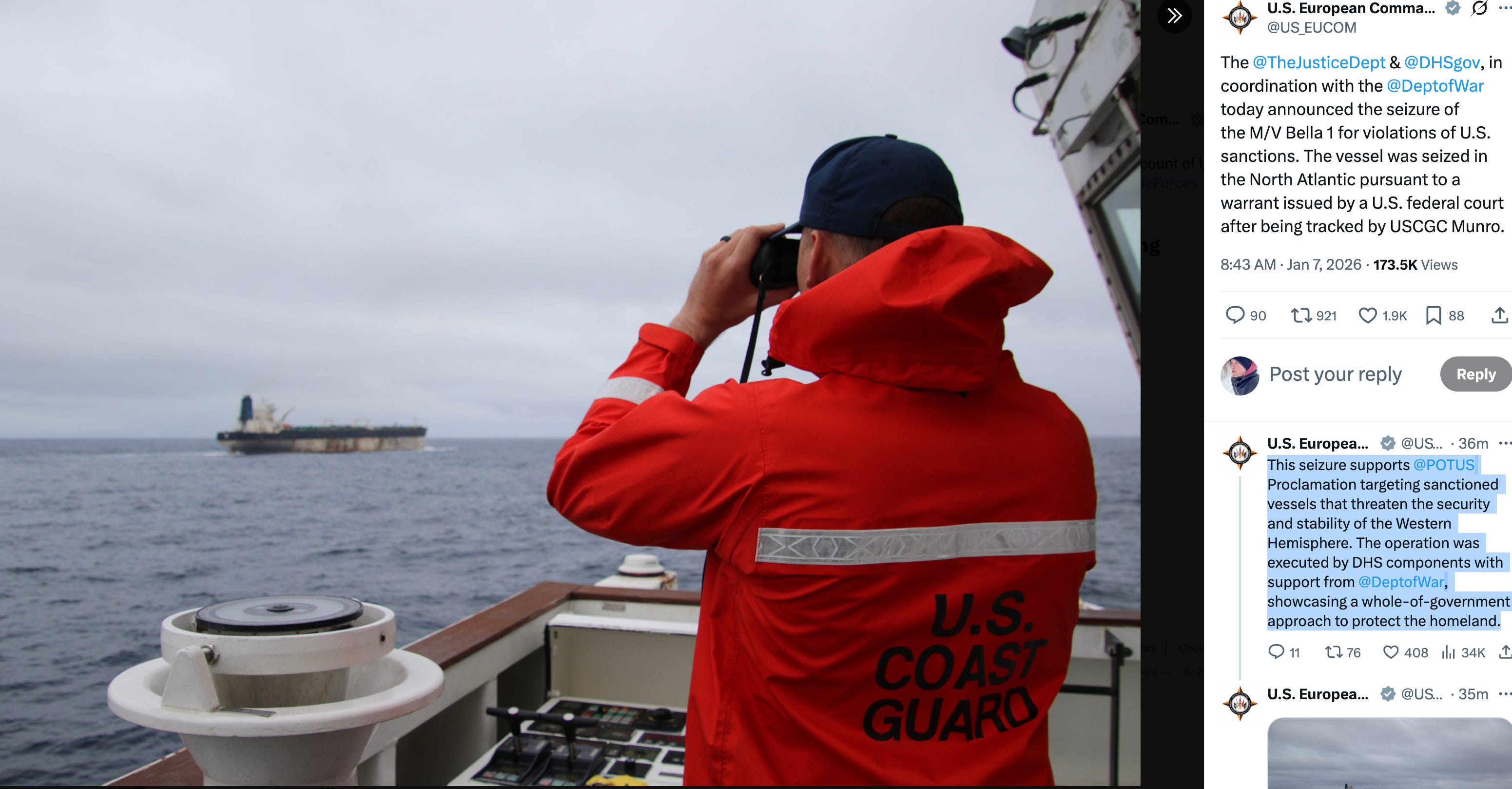
NORTH ATLANTIC — U.S. forces have intercepted and boarded a Russian-flagged oil tanker in the North Atlantic that had evaded an American effort to crack down on Venezuela’s energy exports, military officials said this morning, amplifying a confrontation with Moscow after the stunning ouster of its ally, President Nicolás Maduro of Venezuela.
A post on X at 8:43 a.m. from U.S. European Command said the vessel “was seized in the North Atlantic pursuant to a warrant issued by a U.S. federal court after being tracked by USCGC Munro,” describing the action as the enforcement of U.S. sanctions.
In a second post, the military said: “This seizure supports President Trump’s proclamation targeting sanctioned vessels that threaten the security and stability of the Western Hemisphere. The operation was executed by DHS components with support from the Department of Defense, showcasing a whole-of-government approach to protect the homeland.”
The Coast Guard boarded the tanker after a roughly two-week pursuit, according to reports from the New York Times.
Shipping data and sanctions-tracking specialists have reportedly been following the vessel for weeks under its shifting identity: the tanker is now operating as Marinera, but was previously known as Bella 1—a very large crude carrier that U.S. officials have described as part of a “dark fleet” used to evade restrictions on Venezuelan and Iranian oil movements.
Bella 1 was reportedly “empty” as it approached Venezuelan waters, and it had a documented history of moving Venezuelan crude toward China and previously carrying Iranian crude, according to vessel-monitoring and tanker-tracking services.
The seizure lands inside a rapidly hardening geopolitical and geostrategic backdrop: Moscow had reportedly dispatched naval assets—including a submarine—to escort the tanker as U.S. forces closed in, a move that risked turning sanctions enforcement into a direct U.S.–Russia maritime standoff in the North Atlantic.
Venezuela’s internal crisis increases the stakes.
With Maduro captured and making a first appearance in federal court in New York, denying allegations that he led a narco-state enterprise from Venezuela, Vice President Delcy Rodríguez has been elevated by Venezuela’s top court as interim leader under the constitutional line of succession.
But experts on the state’s power structures—reflected in the Justice Department’s superseding indictment against Maduro and his wife Cilia Flores and other senior regime security and justice officials—indicate the practical power hinges on the officials who control the security services and military patronage networks that kept the regime intact.
Within that inner circle, Washington is now pressing to shape what U.S. officials and analysts have described as a “headless” government.
The Trump administration is reportedly leaning on—and warning—figures such as Interior Minister Diosdado Cabello and Defense Minister Vladimir Padrino López, while demanding steps that include opening oil markets and cutting ties with foreign security partners.
As The Bureau has reported, Cabello is allegedly at the center of Maduro’s narco conspiracy.
For example, in 2006, prosecutors alleged, Venezuelan officials dispatched more than 5.5 tons of cocaine from Venezuela to Mexico on a DC-9 jet. They alleged that Diosdado Cabello, then-director of Venezuela’s military intelligence agency; Hugo Armando Carvajal Barrios, a retired general and military intelligence boss under former president Hugo Chávez; and Venezuelan National Guard Captain Vassyly Kotosky coordinated the shipment with other regime members.
That pressure campaign on Venezuela’s functioning government is being led by Secretary of State Marco Rubio, as the administration tries to force a rapid reorientation away from Caracas’s entrenched relationships with Moscow, Beijing, Tehran and Havana.
U.S. officials are pushing Venezuela to expel advisers linked to those states as part of the post-Maduro reset—an approach that some foreign-policy analysts describe as an updated Monroe Doctrine-style bid to roll back Russian and Chinese influence across the hemisphere amid rising global war fears in Europe and the Indo-Pacific.
Energy is central to that strategy.
On the hard numbers, reporting grounded in tanker-tracking data has put China’s 2025 imports of Venezuelan crude at about 389,000 barrels per day—roughly 4 percent of China’s seaborne crude imports. Separate analysis has estimated Iranian oil accounted for roughly 13.6 percent of China’s crude purchases in 2025. Some commentators argue the combined share is higher once rebranding and opaque routing are fully accounted for.
Either way, the strategic logic circles back to Wednesday’s interception: if Washington can constrict sanctioned Venezuelan barrels while tightening pressure on Iranian flows at the same time—and if Russia is also covertly benefiting from the sanctioned-trade ecosystem—then the United States gains leverage not only over Caracas’s transition, but over a wider great-power contest in which oil supply, sanctions enforcement, and maritime control are increasingly fused into the same operational picture, which may include the risk of conflict spreading across Europe and Asia.


Locking down the western hemisphere and destroying communist countries is vital to the national security of America. If China is going to screw around with minerals and other things needed then they won’t be getting oil from Venezuela. Russia has no real need for oil as they have their own and this was obviously payment for something from Venezuela. Iran is facing serious unrest from its population with 31 of its 42 regions protesting and the Ayatollah already having exit plans should the regime fall and that’s looking more likely by the minute. Should Iran fall and then Cuba would sit alone cut off from Russia and China. They would surely crumble without much resistance and most likely without boots on the ground. Eyes would next fall on Canada. It seems like that would be inevitable to me. Trump is doing all he can to get control of the western hemisphere. This is Reagan-sque from my point of view. You can thank him later. Is it imperialist? Yes. This is what great empires do and it’s how it takes care of its citizens. Liberalism is dying on the vine and I couldn’t be more happy. Good times are a comin’!
Trump’s Art of the Deal (1987) is worth reading by anyone wanting to understand his negotiating methods. Rule #1. Start with a disruption/complaint that throws off the counterpart. So, when he referred to the State of Canada becoming part of the USA (a major disruption in diplomatic entente), the declaration precipitated numerous concessions and willingness to negotiate “unfair” trade deals without having to grab Canada as part of Manifest Destiny. However, as much as some people don’t respect him, he IS effective, and his taking action to interdict drugs and drug making supplies has produced results. Seizing an empty oil tanker with a history of changing spots is as much a message to Iran as it is to Russia and China. Sam’s reporting combines facts with insights, not the usual self-infatuated opinions and “conversations” that substitute for news found on say, the CBC. And, that is why many are paying subscribers.