Update: National Fentanyl Figures Miss B.C.’s Biggest 2025 Precursor Bust – 4,300 Litres from China
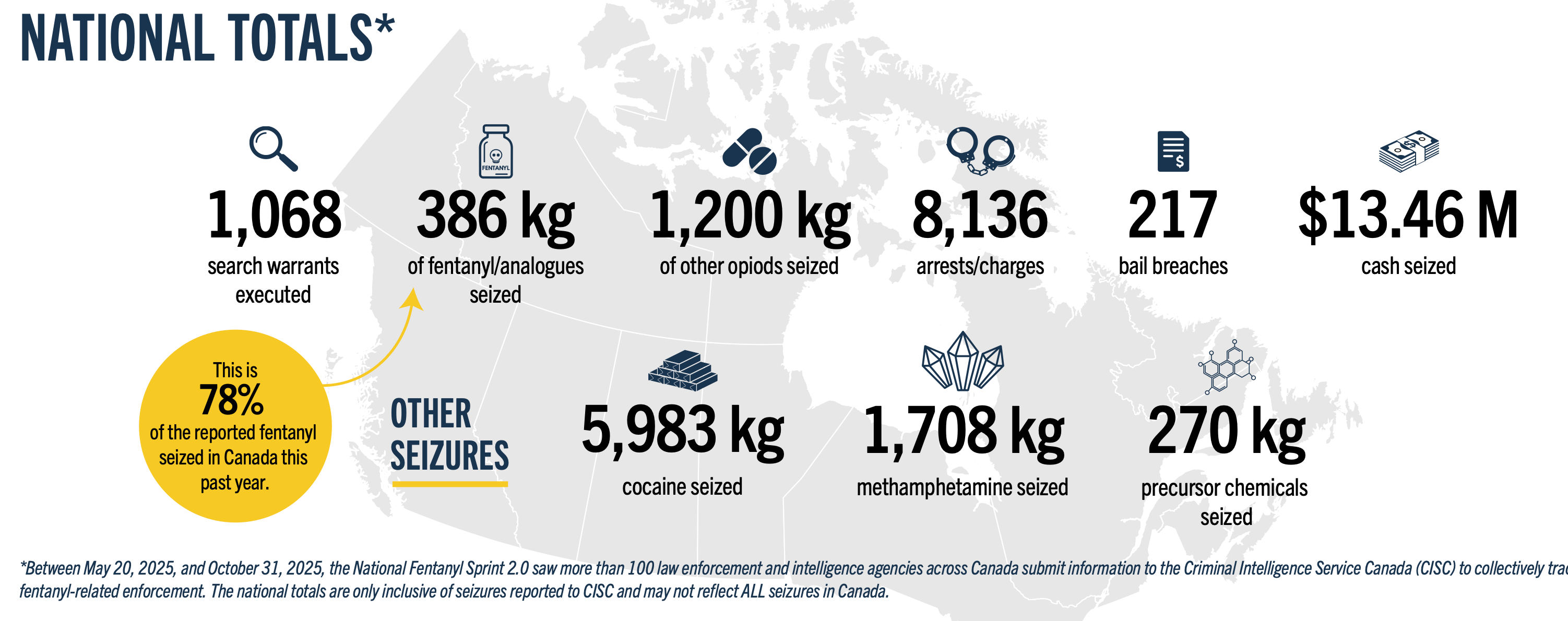
OTTAWA — In less than half a year, a Canadian criminal intelligence report shows, police and partner agencies across the country seized 386 kilograms of fentanyl and analogues in a coordinated national enforcement blitz — with Ontario and British Columbia together accounting for more than 90 per cent of the total.
Border officials stressed they believe the vast majority of the fentanyl seizures were for domestic consumption and not for export to other nations.
According to new data compiled under the National Fentanyl Sprint 2.0, Ontario alone reported 263 kilograms of fentanyl seizures – 68 per cent of the national total – while B.C. logged 88 kilograms, or 23 per cent.
However, the national seizure totals actually understate British Columbia’s role as a major entry point for fentanyl precursors. A massive interception occurred just days before the Sprint 2.0 reporting period began, and was therefore excluded from the 386 kg fentanyl and 270 kg precursor figures presented in the RCMP report.
On May 13–15, 2025, CBSA officers at the Tsawwassen container examination facility in Delta, B.C., inspected marine containers that had arrived from China and were destined for Calgary, Alberta. They discovered more than 4,300 litres of precursor and related chemicals, including 3,600 litres of a precursor for GHB, commonly known as the “date-rape drug”; 500 litres of propionyl chloride, a direct precursor for fentanyl synthesis; 200 litres of gamma-butyrolactone (GBL), a controlled substance that converts to GHB in the body.
This seizure, publicly disclosed in late October 2025, ranks as one of the largest Chinese-sourced precursor-chemical intercepts in British Columbia in the past decade and was not counted in the Sprint totals. Had the chemicals reached clandestine labs, it’s estimated they could have produced enough for billions of lethal doses.
Within the official Sprint 2.0 dataset (May 20–October 31, 2025), only 38 kilograms of precursor chemicals were recorded for British Columbia, with Quebec accounting for the overwhelming majority of the national 270 kg total and Ontario emerging as a secondary hub.
Alberta followed Ontario and B.C. in finished fentanyl seizures with 23 kilograms; smaller but operationally significant quantities were logged in Saskatchewan, Manitoba, and New Brunswick; and trace amounts appeared in every remaining province and territory. The RCMP noted that the Sprint’s 386 kg of fentanyl and analogues represented 78 percent of all fentanyl seized across Canada in the preceding 12 months.
In a technical briefing Tuesday morning, Ottawa’s new fentanyl czar, Kevin Brosseau, joined senior RCMP officials to walk reporters through the numbers. “This is happening in every province, city and region of our country,” he said, adding that 8,000 Canadians died this year, and more than 50,000 in total.
Officials said more than 100 law-enforcement and intelligence agencies fed their search-warrant, seizure and arrest data into the Criminal Intelligence Service Canada between May 20 and October 31, 2025, giving the Canadian Integrated Response to Organized Crime its clearest national snapshot yet of synthetic-opioid enforcement.
Over the sprint period, police reported 1,068 search warrants executed, 8,136 arrests and charges, and 217 alleged bail breaches involving accused fentanyl traffickers – people officers say kept dealing despite already being on release conditions.
The national totals underscore how deeply fentanyl is embedded in a broader synthetic-drug and poly-drug economy, one that ultimately stems from Canada’s deep involvement in the transnational cannabis trade, according to The Bureau’s sources.
Asked if he recognized this evolution, or had been surprised by the scale and spread of fentanyl labs, Brosseau said: “I absolutely underestimated the scale and scope of the fentanyl crisis in this country, manifesting itself across cities and towns and with victims and service providers around the country. I think what you’re seeing here demonstrated today, is a demonstration of the fact that some significant enforcement action has taken place, to be able to disrupt what you just described.”
Alongside the 386 kilograms of fentanyl, CIROC agencies reported seizing 1,200 kilograms of other opioids, 5,983 kilograms of cocaine, 1,708 kilograms of methamphetamine and $13.46-million in cash.
The launch of Sprint 2.0 comes as U.S. President Donald Trump has turned fentanyl into a central irritant in relations with Ottawa, tying a package of steep, “fentanyl-linked” tariffs on Canadian exports to his demand that Canada “fully stop” the flow of synthetic opioids into the United States. Trump has accused Canada of becoming a significant source of fentanyl for the U.S. market – a charge that Prime Minister Mark Carney’s government firmly denies.
That message was reiterated by a CBSA official Tuesday, who said that only “small, personal doses” of fentanyl are being exported out of Canada.
Canadian officials appear to maintain that the bulk of fentanyl overdoses in North America can still be traced back to precursor chemicals from China, Mexican cartels and U.S.–Mexico border routes.
But in recent months, Brosseau and other senior officials have publicly acknowledged that the spread of domestic fentanyl production in Canada was more advanced, and more geographically dispersed, than they understood even a few years ago. The sprint numbers – from Quebec’s chemical stockpiles to B.C.’s super-lab seizures and Ontario’s dominant share of finished product – are now being held up as both evidence of that underestimation and a baseline for whether Brosseau’s new national strategy can actually bend the trend.


This is a good start! It looks like Ottawa is finally waking up to your excellent reporting, Sam.
50,000 people dying from drugs is a dark stain on the blindness issue. Imagine how costly to Canada (especially if these victims were named, Omar Khadr)
Why would criminals respect our borders? We don't enforce them or jail criminals.