


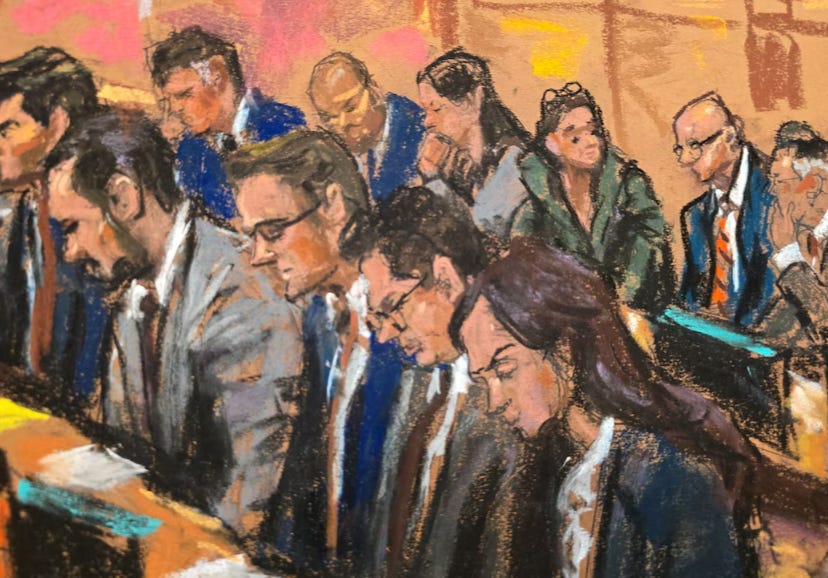
NEW YORK — A federal jury in Brooklyn on Tuesday convicted Huawei on 10 of the 12 criminal counts it faced, including conspiracy to steal trade secrets, while acquitting the company of the government’s racketeering conspiracy charge.
The verdict followed closing arguments in which prosecutors portrayed the company’s alleged thefts, banking deceptions and efforts to obstruct investigators as coordinated actions serving its global business. Huawei’s defense argued that prosecutors had assembled isolated incidents into a false narrative of corporate criminality.
In a statement sent to The Bureau after the verdict, Huawei welcomed the racketeering acquittal and disputed the remaining charges.
“Today, a jury in the United States District Court for the Eastern District of New York acquitted Huawei of the government’s RICO charge.”
“We believe the government’s remaining charges are equally without legal or factual merit,” the statement says. “The five trade secret-related disputes cited by the government were all civil matters that were resolved over the past two decades.”
“We will thoroughly review the relevant verdicts and take all necessary legal actions to defend our rights and interests.”
The competing interpretations of those earlier disputes had been central to the closing arguments. In his rebuttal, Assistant U.S. Attorney Robert Pollack urged jurors to focus on the agreements underlying the conspiracy charges.
“Remember, a conspiracy is an agreement,” he said. “That’s the crime; the agreement itself.”
A day before the verdict, jurors sought guidance on the separate obstruction conspiracy charge, which prosecutors built partly on an intercepted call in which Huawei’s human resources and legal personnel discussed moving employees out of the United States.
On Monday, November 23, jurors asked whether Huawei had appeared pursuant to a subpoena in Washington and whether that investigation had transferred to the Eastern District of New York. Their note concerned Count 12, according to Inner City Press’s courtroom reporting.
The call followed the arrest of a Huawei employee who had worked on the company’s Iran business. The conduct underlying his arrest was withheld from the jury. But prosecutors argued that the company’s legal and human resources officials treated the arrest as a pretext for obtaining information about Huawei.
“What they did is they spoke completely dismissively of the arrest,” Pollack told jurors in his November 17 rebuttal.
Pollack said the call participants discussed getting other employees who had worked in sanctioned countries out of the United States immediately. He argued that their response revealed concern about investigators reaching the company’s evidence.
“Their first instinct is not to believe it, and to assume he wasn’t a rogue employee who did some crime on his own, but actually to assume that was all for show, and his arrest was really because the government was collecting evidence of Huawei’s crimes, so they need to get all of the evidence, out of the US and obstruct justice ASAP,” he said.
The human resources official, Pollack argued, was “clearly proposing a conspiracy to obstruct justice; clearly saying we need to get these people out of the country if they have information about our work in sensitive countries, absolutely.”
The defense argued that only one of the Huawei employees on the call had proposed removing employees and that the other never agreed.
Pollack said the defense had shown jurors “selective snippets” of the transcript. “I think you should read it,” he told them. “That lawyer does agree with it.”
He pointed to the Huawei lawyer on the call, identified as Guo Li, who acknowledged that some employees had been sent out of the country for business reasons but warned that “the current situation” was different. “This was the legal person on the call, the other party,” Pollack said, not the human resources official the defense had highlighted.
He urged jurors “as enthusiastically as I can to read every word of that exhibit.”
“It speaks for itself,” he said.
Beyond the call, Pollack’s rebuttal turned on a broader dispute with the defense over what the law requires jurors to find before they can conclude that a conspiracy existed.
Huawei and its co-defendants denied the charges. The defense maintained that prosecutors assembled scattered incidents and legitimate business decisions into a false narrative of corporate criminality, discounting Huawei’s engineering achievements and its efforts to correct employee misconduct.
“They began with guilt and worked backwards,” defense lawyer Brian Heberlig told jurors in his closing, according to Reuters.
The bonus policy highlighted in The Bureau’s reporting became Pollack’s most pointed example of common purpose.
Former Huawei trainer Heather Campbell had described receiving a headquarters document offering rewards for competitors’ information, with the most confidential material to be encrypted and transmitted to China. She reported it to the Federal Bureau of Investigation.
