


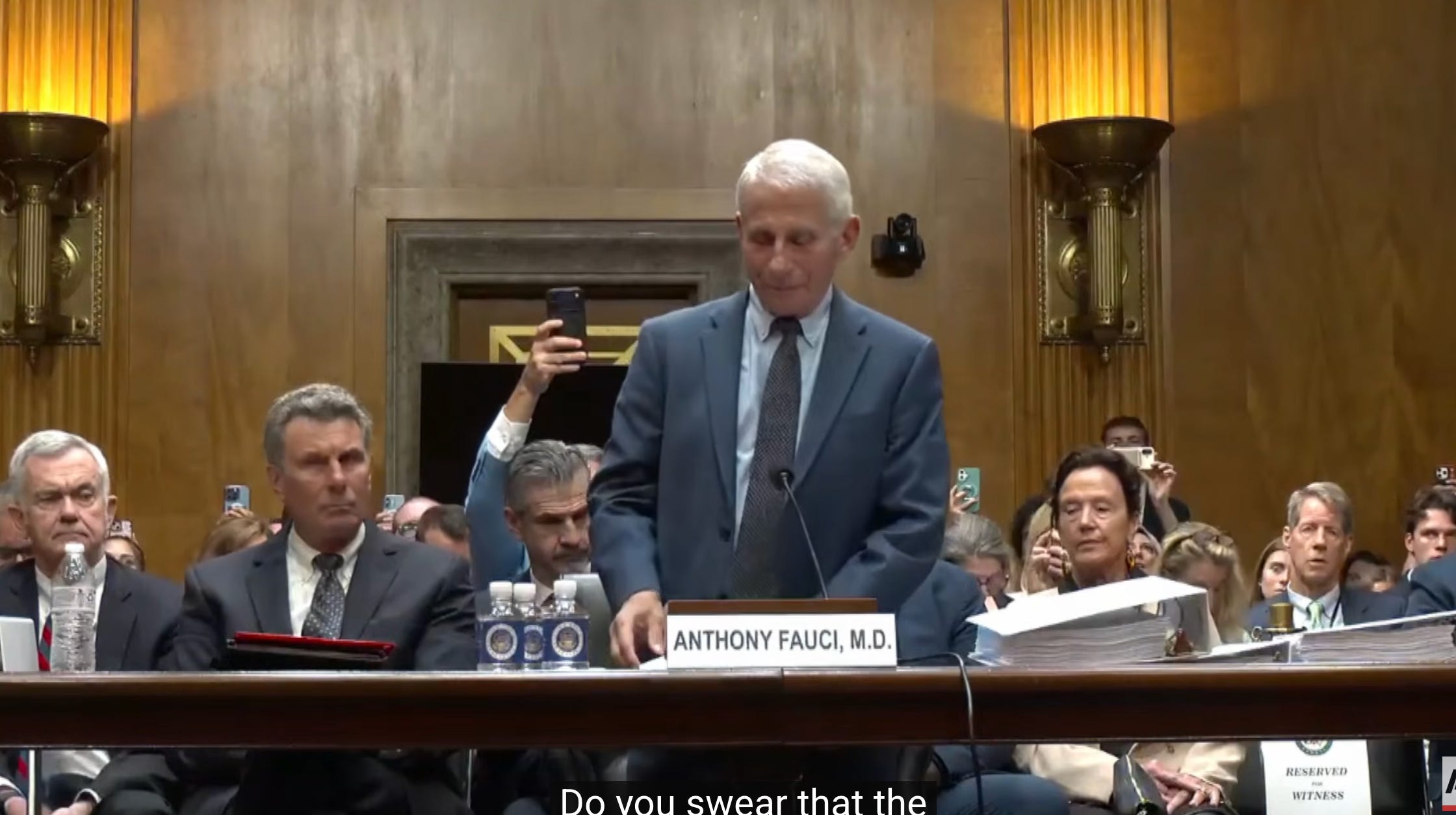
WASHINGTON — Senator Rand Paul opened a subpoenaed hearing in Washington this morning with an indictment rather than a question, accusing the former head of America’s infectious disease agency of operating under a conflict of interest from the earliest days of the pandemic. Anthony Fauci sat in silence before standing and defiantly invoking the Fifth Amendment, accusing Paul of leading an “unhinged” effort to put him behind bars.
At stake is not only whether Fauci misled Congress, but whether Western intelligence reached the correct conclusion years ago and buried it.
The decision to fund what Paul called dangerous gain-of-function research in Wuhan would likely go down in history as one of the worst public-health decisions ever made, the Kentucky Republican said. He said he hoped Fauci would come clean, concede that the risks had exceeded any conceivable benefit, ask forgiveness and help design safeguards against a manmade epidemic.
Fauci’s answer was refusal.
“Dr. Fauci, were the scientists at the Wuhan Institute of Virology capable of inserting a furin cleavage site into a coronavirus?” Paul asked.
“On the advice of counsel, I respectfully decline to answer based upon my rights under the Fifth Amendment to the Constitution,” Fauci answered, as he did repeatedly in response to Paul’s questions.
Before refusing to answer the questions put to him, Fauci told the committee he had spent 38 years as director of the National Institute of Allergy and Infectious Diseases and had testified before or briefed congressional committees well over 200 times. He said he had appeared repeatedly during and after the pandemic, usually under oath, and had sat for days of transcribed, sworn interviews concerning the same questions now before the committee.
What had changed, he said, was the chairman. He cited Paul’s “obvious obsession with calling for my prosecution,” his “repeated slanderous comments,” and his decision to publish Fauci’s unredacted personal diary — an act Fauci said was aimed at embarrassing and intimidating him. The only conclusion available to him, he said, was that he had been summoned “to get me to say something, anything that could vindicate his repeated public pledges that I end up in his words, ‘Behind bars.’”
Paul’s charge was that Fauci privately understood a Wuhan lab leak was plausible but publicly sponsored the counter-narrative for political reasons.
On a conference call about the virus’s origin, all but two participants thought deliberate insertion through gain-of-function research was possible, Paul said.
That same week, Paul said, Fauci ordered an urgent internal check on whether his own agency had financed the research now under suspicion. Within hours an assistant reported back that the Wuhan experiments had been reviewed and approved by the National Institutes of Health, or NIH.
“Those were not the actions of officials who believed that a research related origin was an absurd conspiracy theory,” Paul said. They were the actions of officials trying to establish whether their own funding was connected to the pandemic.
What followed, in Paul’s telling, was the construction of a defense.
