'Big Brothers' of Chinese Transnational Crime Ran Global Fentanyl Cash Laundering for Sinaloa and Jalisco Cartels, from Dubai to Latin America
ALEXANDRIA, Va. — In a case kept largely under seal to protect an active investigation and the safety of witnesses, two alleged senior figures in Chinese transnational criminal networks — each carrying the “Big Brother” honorific that signals high-ranking leadership — have been charged in a United States federal court with laundering fentanyl proceeds for the Sinaloa Cartel and the Cartel de Jalisco Nueva Generación, according to court documents obtained by The Bureau.
Ruhuan Zhen, who operated under the names “Black Wisdom,” “Black Zhi,” and “Black Pig,” and Hongce Wu, known as “Big Brother Ce” and “Chaud,” were indicted April 24, 2025, by a federal grand jury in Alexandria, Virginia. Both defendants remain at large.
Court records show the investigation of Zhen stretches back considerably further. A criminal complaint, supporting affidavit, and arrest warrant were filed under seal against Zhen alone on October 27, 2023 — more than 18 months before Wu was added and the joint indictment returned — indicating federal investigators had been building the case against him for years before prosecutors were prepared to charge.
One document — Docket No. 2 — remains under seal. The court found its disclosure would jeopardize an ongoing criminal investigation and endanger witnesses, language that signals the investigation remains active and that additional targets may not yet have been charged.
According to court documents, beginning in at least November 2016 and continuing to April 2025, Zhen, Wu, and their co-conspirators used an array of clandestine financial methods — including mirror transfers, foreign bank accounts, encrypted communications applications, a serial-number verification system, and trade-based money laundering — to move substantial volumes of drug proceeds on behalf of transnational criminal organizations.
The conspiracy spanned the United States, Mexico, Colombia, China, Dubai, and elsewhere, and involved proceeds from the trafficking of cocaine and fentanyl.
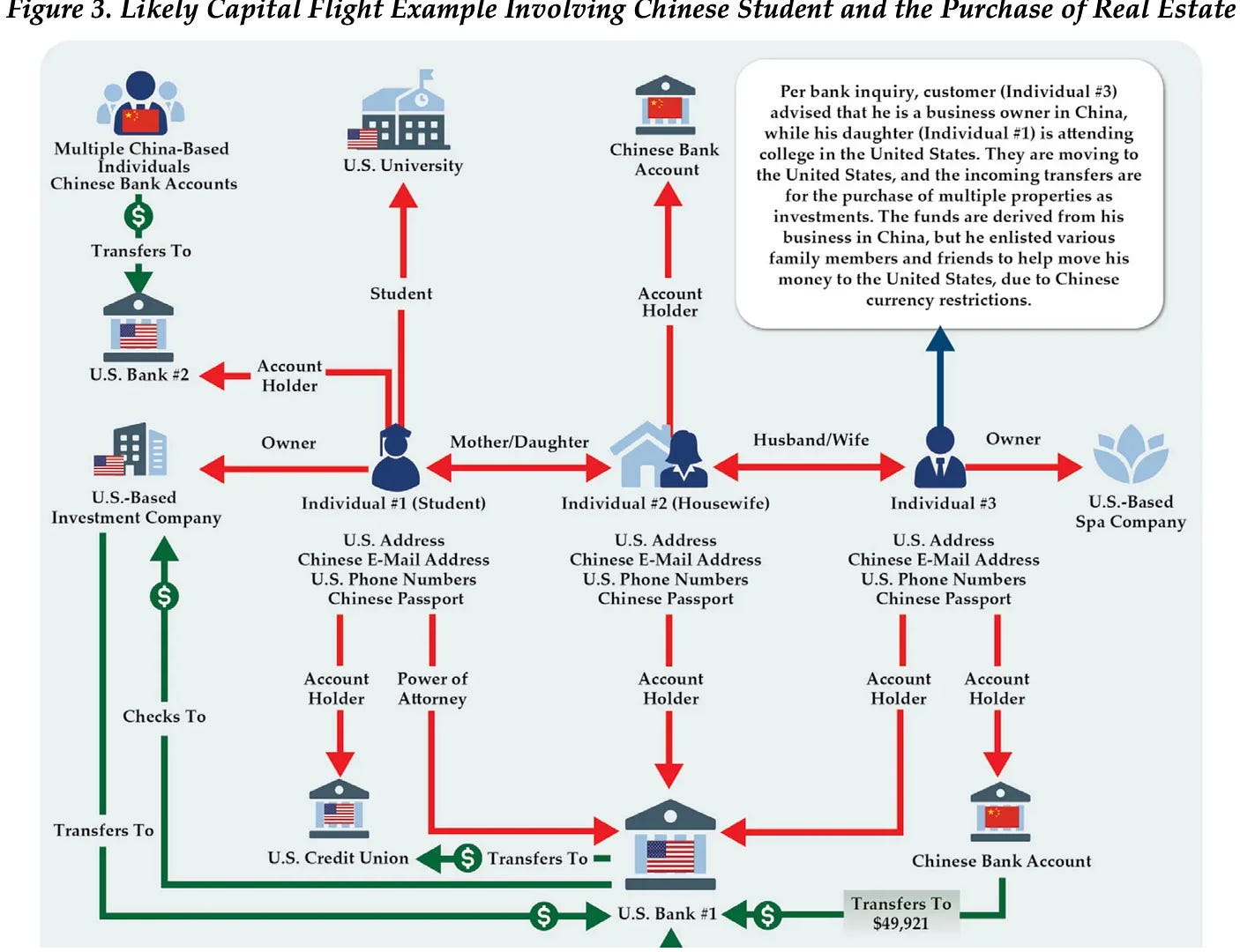
The methods alleged against Zhen and Wu mirror techniques documented across multiple U.S. law enforcement and financial intelligence investigations. The DEA’s Operation Sleeping Giant and a U.S. Treasury report flagged $312 billion in cartel-linked suspicious transactions and $53.7 billion in illicit real estate activity over four years, identifying Chinese underground banking as a primary driver of Mexican cartel expansion into the United States. Treasury’s Financial Crimes Enforcement Network separately flagged $766 million in suspicious activity at New York elder care centers and nearly 1,700 reports tied to human trafficking — evidence of how thoroughly these networks have penetrated legitimate institutions.
As The Bureau has reported, Canada’s FinTRAC has raised identical alarms about Chinese underground banking in Toronto, tracing patterns of money mules using false occupations to move large volumes of cash — schemes whose origins investigators trace to drug-money laundering through British Columbia’s government casinos more than a decade ago.
The case was investigated by the Drug Enforcement Administration’s Special Operations Division, Bilateral Investigations Unit, with support from DEA field offices across the United States and in Bogota and Dubai — a geographic footprint that reflects the global reach of the alleged laundering network.
If convicted, Zhen and Wu each face a maximum of 20 years in federal prison.


