

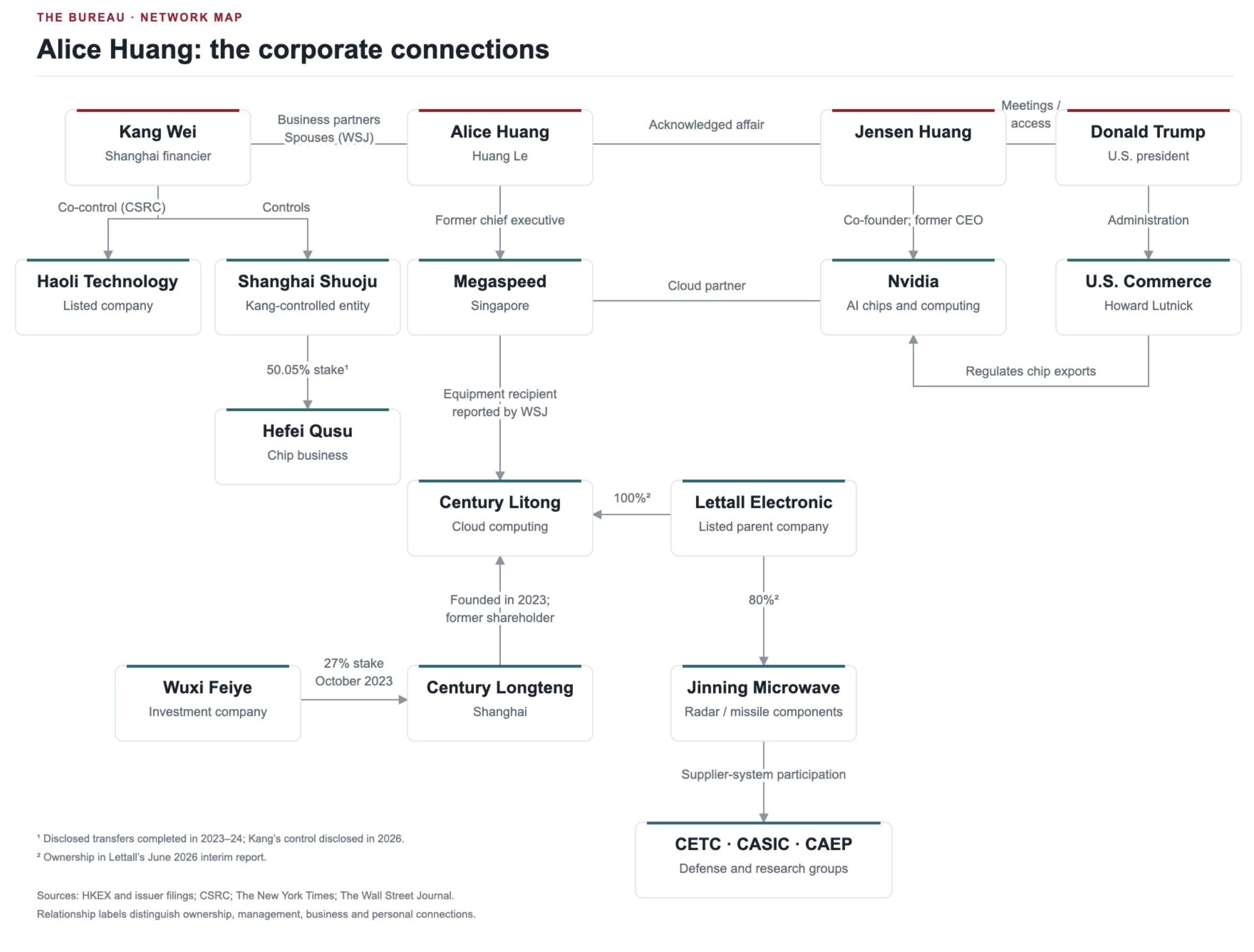
WASHINGTON — An alleged Chinese intelligence operation rarely reaches the American public through a story this intimate, or a business this consequential to global security.
A celebrated technology founder builds a trillion-dollar company and enjoys direct access to the Oval Office. A Chinese state-television journalist abruptly blossoms into a Shanghai financier who wins access to his company and his social circle. An affair, denied but suggested in social-media photographs, is finally acknowledged.
But before that, billions of dollars in advanced chips flow through the Shanghai financier’s fledgling business, acquired through a Caribbean-registered company, and allegedly onward to companies with supply-chain links to China’s defense industry.
Buried beneath the layers is the secret struggle between Washington and Beijing over frontier artificial-intelligence models—and the title of global hegemon.
The story has the familiar elements of a Cold War arms-race drama, transplanted into 2026 and an industry whose products are so powerful and cutting-edge that even the titans developing them in the United States struggle to contain them—both the potential for AI systems to act beyond human direction and their spread into dangerous hands.