BROOKLYN, New York — “Theft, lies, cover-up.”
That was how Justice Department lawyer Taylor Stout opened the United States government’s criminal case against Huawei Technologies, alleging that the Chinese telecommunications giant spent two decades stealing American technology, deceiving global banks and concealing its business with Iran’s repressive regime.
The government’s first witness took the jury into the prosecution’s claim that Huawei assisted Iran’s domestic-surveillance machinery.
Parham Baheshti, a U.S. citizen who worked in Iran during the regime’s violent suppression of protests in 2009, told jurors that Huawei representatives made a pitch for “analyzing the Iranian people and their behavior online,” according to Associated Press reporting.
He later supplied information about his Huawei dealings to the U.S. government and left Iran in 2011 after learning that he was under investigation.
His testimony opened one of the most consequential corporate criminal trials ever brought against a Chinese company—and put a human witness behind the government’s allegation that Huawei assisted one of Washington’s principal adversaries with domestic repression.
Huawei’s lead lawyer, Brian Heberlig, told jurors that the government had distorted ordinary global commerce and isolated employee misconduct to portray a multinational corporation as a criminal organization.
“There was no blueprint for crime,” he said.
The trial before U.S. District Judge Ann M. Donnelly is the culmination of a prosecution that began under seal in 2018, burst into public view with Meng Wanzhou’s arrest in Vancouver and expanded in 2020 into a sweeping racketeering case.
The fourth superseding indictment contains 14 counts, although prosecutors said shortly before trial that they would not proceed on two sanctions counts.
In the same September 4 filing, prosecutors said they would no longer rely on a trade-secret episode involving anonymous “Company 2”—identified in reporting as Motorola Solutions—as a predicate act supporting the racketeering charge. The remaining allegations include racketeering conspiracy, conspiracy to steal trade secrets, bank and wire fraud, money laundering and obstruction of justice.
The geopolitical implications reach far beyond an ordinary corporate prosecution. U.S. officials have long suspected that Huawei’s technology and global reach serve Beijing’s strategic interests.
Donnelly nevertheless cautioned prospective jurors: “China and the Communist Party … are not on trial.”
Yet the extraordinary events surrounding the case point directly back to Beijing.
As The Bureau’s reporting on a classified CSIS assessment reveals, China’s intelligence service mounted an intensive pressure and interference campaign in Canada aimed at preventing Meng’s extradition—the outcome Beijing feared could lead her to cooperate with U.S. investigators and disclose privileged information.
On December 1, 2018, the RCMP arrested Meng, Huawei’s chief financial officer and the daughter of founder Ren Zhengfei, at Vancouver International Airport on a U.S. extradition request.
Nine days later, Chinese authorities detained former Canadian diplomat Michael Kovrig and businessman Michael Spavor on espionage allegations. A classified CSIS assessment reviewed exclusively by The Bureau reveals that Canadian intelligence viewed the detentions and Meng’s extradition proceeding as elements of a pressure campaign directed by the highest levels of China’s state-security apparatus.
The June 10, 2019, “Canadian Eyes Only” assessment—titled PRC Strategy and Tactics to Influence the Meng Proceedings—said Ministry of State Security units were tasked “from high levels” to respond to Meng’s arrest. Regional MSS bureaus competed to make the “largest possible impact,” while President Xi Jinping received reporting on the crisis directly from the intelligence service, according to CSIS.
The campaign combined trade retaliation, pressure on politically connected Canadian business leaders, clandestine interference in the 2019 federal election and the detention of Kovrig and Spavor.
“The PRC is calibrating its clandestine interference in the 2019 federal election to reflect its displeasure with Canada’s current political leaders,” the assessment said. “Multiple corroborated reports confirm that PRC missions in Canada are moderating their support for the Prime Minister and other Liberal candidates.”
At the same time, CSIS reported that Chinese missions were providing clandestine support to candidates from all three major parties—”hedging its bets” in an unpredictable election to maximize Beijing’s influence.
CSIS assessed that Beijing regarded the Canadians’ detention as retaliatory, but also useful as a pretext for “quiet communications” with Ottawa outside normal diplomatic channels. Beijing’s multidimensional campaign, the agency predicted, would remain in place until Meng’s extradition proceedings ended.
Paradoxically, Canadian intelligence believed Beijing expected Canada would ultimately extradite her.
Most explosively, “uncorroborated single source” intelligence indicated the PRC might consider Meng’s “exfiltration or assassination” if that became the only alternative to significant national harm.
Other public reporting shows how the solution developed.
In June 2019, The Globe and Mail reported that Canadian academic Wenran Jiang had advanced the possibility that Ottawa could terminate the extradition under section 23(3) of Canada’s Extradition Act. Former Liberal prime minister Jean Chrétien then began floating intervention by the federal justice minister.
Huawei considered Jiang helpful to its campaign to influence Canadian public opinion, The Globe and Mail reported.
At the G20 summit in Osaka that month, Prime Minister Justin Trudeau reportedly slipped Xi a Mandarin note proposing private discussions. Days later, Trudeau’s economic adviser—and future Canadian ambassador to China—Dominic Barton held an unofficial meeting in Beijing during which a Chinese official specifically cited section 23(3), according to a detailed Wall Street Journal reconstruction.
After Joe Biden defeated Donald Trump in November 2020, Trudeau placed Kovrig and Spavor at the top of the agenda for his first bilateral meeting with the new president. By mid-2021, the Journal reported, Barton and Chinese counterparts were working toward a resolution that would return Meng to China and free the two Canadians.
According to the Journal, Chinese lawyers supplied proposed language for a U.S. deferred-prosecution agreement on September 19, 2021. Canada voted the next day, returning Trudeau’s Liberals with another minority government.
On September 24, Meng agreed to the accuracy of a four-page statement detailing false representations she made to a global bank concerning Huawei’s control of Skycom and its Iranian business.
Washington withdrew its extradition request.
Canadian Justice Minister David Lametti terminated the proceeding under section 23(3), and Meng departed for China. Kovrig and Spavor were released within hours.
The deal did not end the prosecution of Huawei.
In June 2026, Donnelly ruled that Meng’s statement of facts could be presented to the jury as evidence against the company. Meng was—and remains—Huawei’s chief financial officer, the judge reasoned, and Huawei had adopted her account of conduct undertaken in her corporate role.
Huawei Technologies and three subsidiaries have pleaded not guilty.
Prosecutors allege that the companies operated as a criminal enterprise from approximately 1999 to 2020, acquiring American intellectual property through fraud, employee recruitment and theft while rewarding personnel who obtained confidential information from competitors.
The 2020 superseding indictment alleges Huawei installed surveillance equipment “used to monitor, identify and detain protestors” during Tehran’s 2009 demonstrations. It describes Huawei’s broader conduct as “deliberate and repeated misappropriation of intellectual property.”
The 2019 indictment alleges Huawei “made efforts to move witnesses with knowledge about Huawei’s Iran-based business to the PRC … and to destroy and conceal evidence.”
Meng’s signed statement of facts says “Huawei controlled Skycom, and Skycom employees were really Huawei employees,” and that Huawei caused approximately $100 million in Skycom transactions to clear through the United States.
The alleged targets identified in reporting included Cisco Systems, Motorola Solutions, Fujitsu, Quintel Technology, T-Mobile and CNEX Labs. The disputed technology ranged from router source code and operating manuals to antenna designs and a robotic testing arm that a Huawei employee allegedly removed from a T-Mobile laboratory in a laptop bag.
Another branch of the case centres on Skycom, a Hong Kong company prosecutors describe as an unofficial Huawei subsidiary used to conduct business in Iran. The government alleges Huawei concealed that relationship from HSBC and other banks while causing approximately $100 million in Skycom-related transactions to clear through the American financial system.
The trial continues today in Brooklyn.
Meanwhile, the conduct attributed to Beijing in the Meng case could be viewed as continuing today, in trade battles around the world.
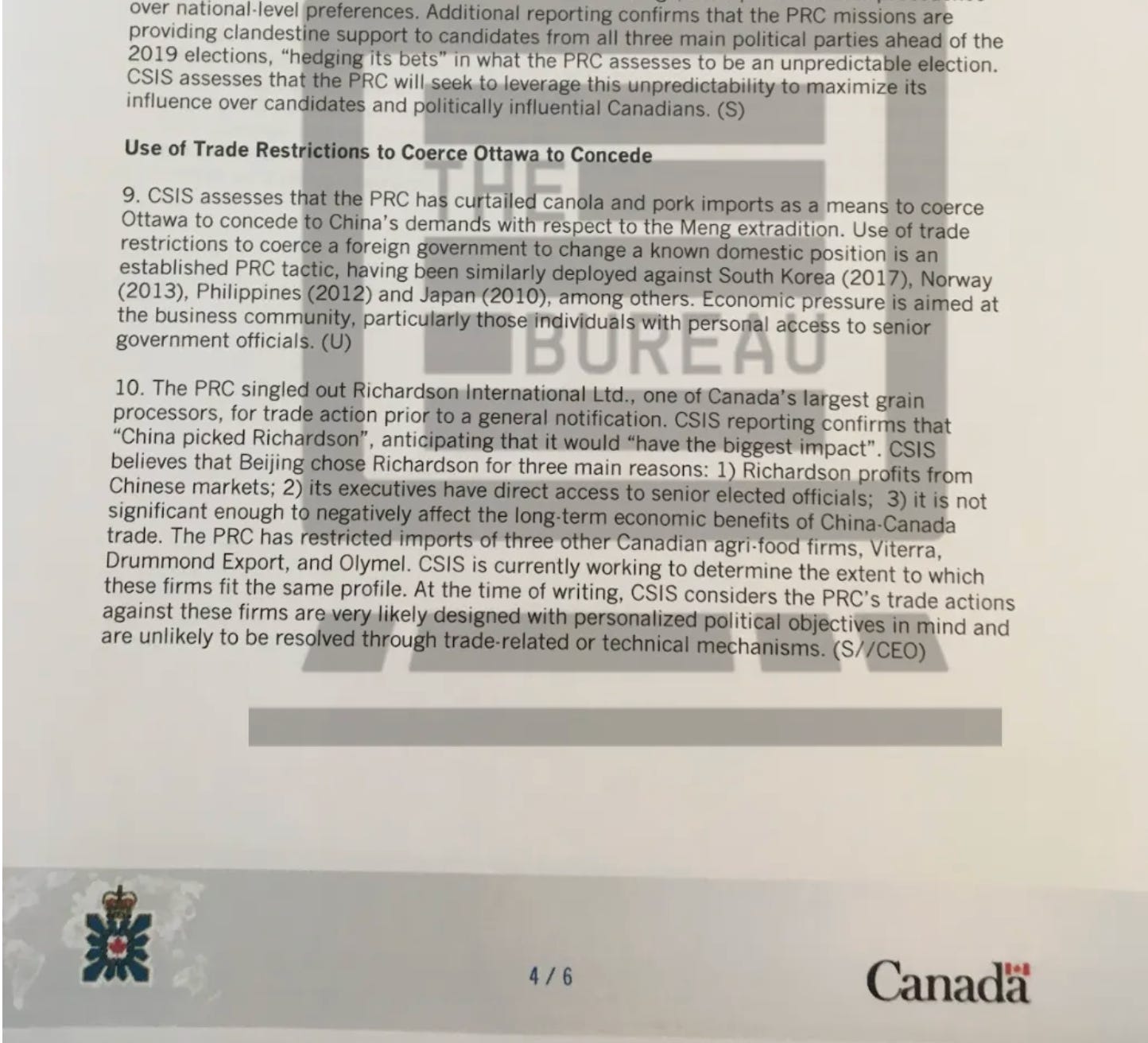
Under a heading reading “Use of Trade Restrictions to Coerce Ottawa to Concede,” the assessment states that CSIS “assesses that the PRC has curtailed canola and pork imports as a means to coerce Ottawa to concede to China’s demands with respect to the Meng extradition.”
The agency described the method as routine rather than improvised. “Use of trade restrictions to coerce a foreign government to change a known domestic position is an established PRC tactic,” the document says, “having been similarly deployed against South Korea (2017), Norway (2013), Philippines (2012) and Japan (2010), among others.”
The target was not the Canadian economy but its leaders.
“Economic pressure is aimed at the business community, particularly those individuals with personal access to senior government officials,” CSIS wrote.
The assessment then names the company Beijing chose first. The PRC “singled out Richardson International Ltd., one of Canada’s largest grain processors, for trade action prior to a general notification,” it says, and “CSIS reporting confirms that ‘China picked Richardson’,” anticipating that the move would “have the biggest impact.” The agency set out three reasons it believed Beijing selected the firm: Richardson profits from Chinese markets, its executives have direct access to senior elected officials, and it is not significant enough to damage the long-term economic benefits of China-Canada trade.
China also restricted imports from three other Canadian agri-food firms — Viterra, Drummond Export and Olymel — and CSIS said it was working to determine how far those companies fit the same profile.
None of the four was accused of any wrongdoing. They were, in the agency’s reading, instruments.
“At the time of writing, CSIS considers the PRC’s trade actions against these firms are very likely designed with personalized political objectives in mind and are unlikely to be resolved through trade-related or technical mechanisms,” the assessment concluded.
Editor’s note: The charges against Huawei are allegations. The defendants have pleaded not guilty and are presumed innocent unless proven guilty beyond a reasonable doubt.


The US should have taken her back in a burlap sack (she was living large all over Vancouver & Whistler) it would be the same way china goes after foreigners with impunity.
The Chinese/CCP are sneaky bastards and smile as they lie right to your face. They are thieves and liars. The first Trudeau opened the door to them and they've been stealing and cheating and lying ever since.