Auditor General Finds Canada's International Student Program Overwhelmed by Fraud, With No Plan to Act on Those Who Cheated Their Way In
OTTAWA — Immigration fraud has overwhelmed Canada’s international student program, the Auditor General found Monday, with 153,000 students flagged as potentially non-compliant, funding to investigate only 2,000 potential fraud cases per year, and nearly all of 800 individuals who fraudulently entered Canada later approved for permanent status or immigration extensions.
One number above all others defines the scale of the failure: of 153,000 international students flagged as potentially non-compliant with Canadian study permit conditions, the federal government investigated fewer than 4,100 — laying bare an enforcement system so overwhelmed it cannot meaningfully police the program it is mandated to protect.
Those findings validate what The Bureau first reported from inside British Columbia’s multi-agency anti-extortion task force — that Canada’s immigration enforcement system has been overwhelmed by transnational organized crime exploiting a student visa program that spiraled out of control, leaving investigators struggling to counter networks now driving a national security crisis of extortion shootings in Surrey, Brampton, Edmonton, and Winnipeg.
The report found that of the investigations the department did launch, roughly 40 percent stalled because students simply did not respond to government requests for information.
Those findings track with precision against The Bureau's reporting, based on accounts from inside British Columbia's multi-agency anti-extortion task force, which described organized crime exploiting immigration volumes and flooding the system with fraudulent paperwork. "We just have no capacity to police this," a government investigator tied to the task force told The Bureau, "and now we're just living it out on the streets every day in Surrey and in Brampton."
The source said police investigations had found Indian international students were being employed by transnational crime networks to target the Sikh community with threats and extortion — in cases that Canadian investigators and foreign intelligence had linked to the Indian state. India strongly denies the allegation.
The Royal Canadian Mounted Police said in 2024, under the Trudeau government, that it had strong evidence to support those claims. Under Prime Minister Mark Carney, the force has reversed course — saying it can no longer connect current transnational repression files to the Indian state.
The report’s most striking data point concerns what happened after fraud was detected. In three investigations, the department identified 800 study permits issued between 2018 and 2023 for which applicants had used fraudulent documentation or misrepresented information to gain entry into Canada — documentation that The Bureau‘s task force source attributed not to individual deception but to sophisticated organized crime networks manufacturing and trafficking immigration paperwork at industrial scale.
Once inside Canada, those 800 individuals did not disappear.
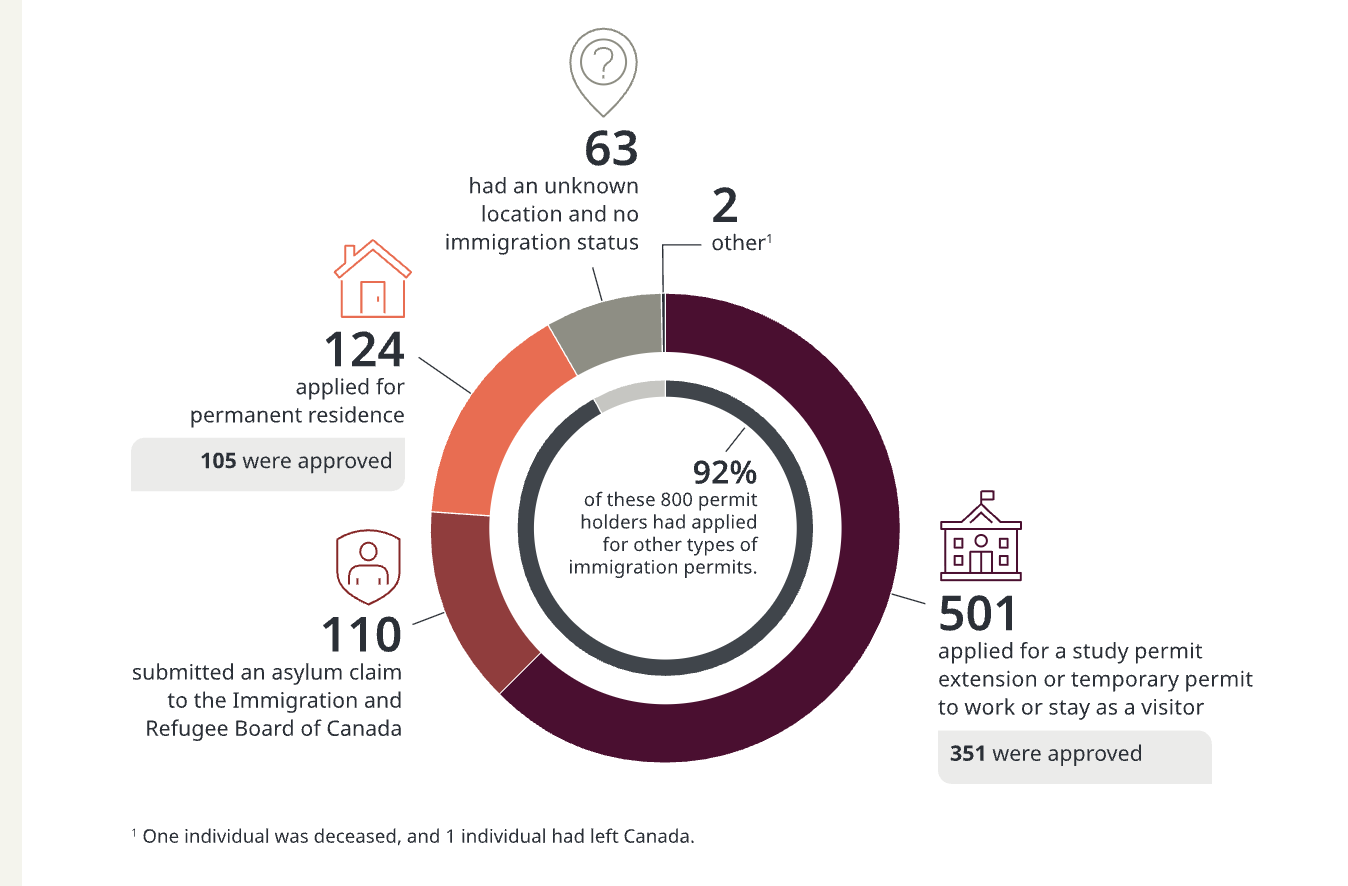
They moved — systematically — into separate immigration streams, each adjudicated independently, with little apparent flagging of the original fraud. Of those 800, 92 percent subsequently applied for other immigration permits and were approved at striking rates: 501 sought study permit extensions or temporary work and visitor permits, of whom 351 were approved; 124 applied for permanent residence, of whom 105 were approved; and 110 filed asylum claims with the Immigration and Refugee Board.
In other words, the 92 percent does not describe how many got through the door on fraud — it describes how many, having already gotten through, were subsequently waved deeper into the system by a bureaucracy that did not connect their applications to the original deception.
That pipeline — fraudulent entry followed by deliberate navigation through progressive immigration streams toward permanent status — is precisely what The Bureau‘s task force source described as an end-to-end assembly line: designated learning institutes, immigration consultant storefronts, forged employment documents, and ultimately a pathway to citizenship, each step controlled and monetized by transnational organized crime.
The report also echoed a figure The Bureau surfaced from inside the enforcement system: 47,175 international students missing across Canada.
The Auditor General’s findings place that number in the context of a letter-of-acceptance verification system that, while processing more than 841,000 applications, flagged just 1.4 percent for potential fraud — leaving the vast majority of the missing student population to vanish into an underground workforce without triggering meaningful enforcement response.
The Auditor General identifies letter-of-acceptance fraud as a central integrity failure. The Bureau‘s task force source described a parallel and arguably larger market in Labour Market Impact Assessments — employment documents trafficked by Indian mafia networks at prices reaching $45,000 each, turning an administrative safeguard into a pay-to-enter instrument on the road to permanent status.
The report flags that 110 of the 800 fraudulent permit holders filed asylum claims. The Bureau reported that extortion suspects facing deportation in British Columbia were doing the same — filing refugee claims as a deliberate legal strategy to pause removal proceedings for months or years. The report provides the first official data confirming the mechanism exists at scale.
The Auditor General has also found that the department has not determined how or when it will use the mechanisms available to it when its own risk processes detect fraudulent documentation or misrepresentation after a permit has already been approved. In plain terms, Ottawa knows that foreign nationals defrauded Canada’s international student system to pursue citizenship — and has no plan to act on that criminality, or to address the dangerous actors who exploited it.


"The report flags that 110 of the 800 fraudulent permit holders filed asylum claims. The Bureau reported that extortion suspects facing deportation in British Columbia were doing the same — filing refugee claims as a deliberate legal strategy to pause removal proceedings for months or years. "
First off this bogus loophole needs to be closed immediately. If they were here in Canada as a student there is no way in hell they should be allowed to apply for asylum especially when the waitlist for the current ~ 250K claimants is what about 3 years. And while on the asylum wait list the Canadian taxpayer funds healthcare, dental care, accommodation, etc.
Increasingly I find it hard to believe this is simply incompetency on the part of the Liberals rather it is all part of the open borders ideology. Just another version of Roxham Road.
HOW much more is it going to take until the Elbows Crowd WAKE UP!