

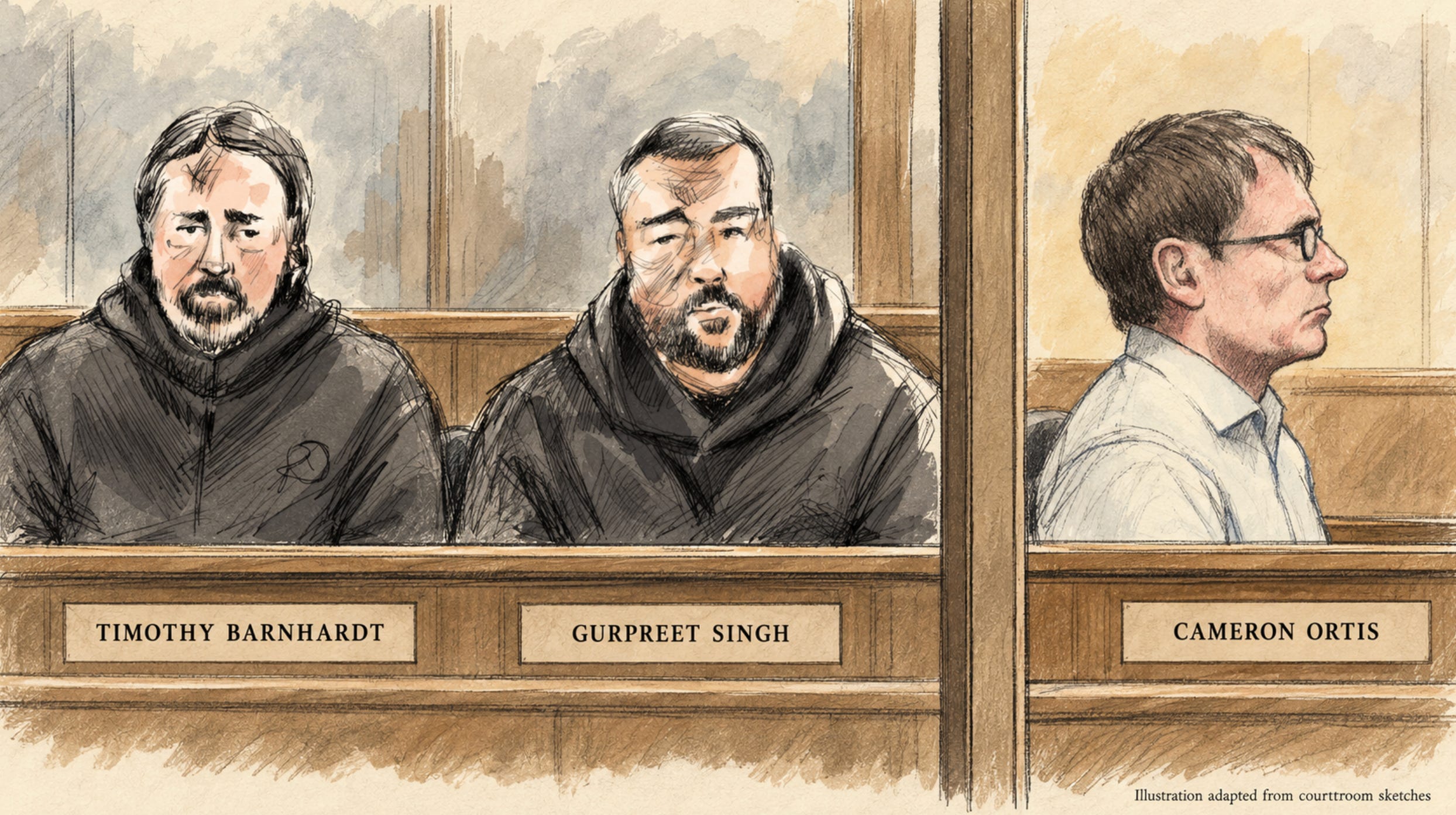
OTTAWA — As evidence mounts of Chinese, Mexican cartel and Iranian-linked penetration of Canada’s official institutions and its big banks — a dimension still largely unexamined outside testimony in the Cameron Ortis case, in which the RCMP’s intelligence director was convicted of leaking Five Eyes secrets to large-scale Toronto money launderers tied to terror and Iran — a Canadian judge has decided citizens must see the alleged police corruption that York Regional Police merely stumbled upon while investigating a plot to murder a senior jail official.
The conspiracy, allegedly directed from a jail cell, linked an accused Toronto fentanyl trafficker, a Toronto police officer accused of dealing drugs, and Gurpreet Singh, an alleged cocaine distributor for Ryan Wedding. Singh was being held in Toronto while fighting extradition to face trial with Wedding in the United States. According to separate police filings, he had also been held captive in 2024 by cartel members in Sinaloa, purportedly over a $600,000 drug debt.
Toronto Const. Timothy Barnhardt, who is accused of drug trafficking, allegedly exploited sensitive databases to sell the addresses of people targeted for murder and other violence by Toronto criminal networks linked to Wedding. The former Canadian Olympian has become a significant player for Latin American cartels, according to the U.S. government.
"The importance of public scrutiny in this case cannot be overstated," Ontario Superior Court Justice Laura Bird wrote in reasons released September 16. "What is, perhaps, most concerning about the allegations of widespread police corruption in this case is the fact that the York Regional Police only stumbled upon it in the course of their investigation into the conspiracy to murder the correctional officer. They conducted a search to determine who may have recently queried the victim's address and learned that Mr. Barnhardt had. There is no evidence that anyone was suspicious of Mr. Barnhardt or his associates until that moment."
“That is something that should be of tremendous concern to the public,” she continued, “because it demonstrates that a trusted public official can engage in widespread illegal conduct and go undetected.”
Consider the chain of events.
A gunman went to the home of a senior corrections official in June 2025 and confronted his grandfather. Police asked who had recently looked up the official’s address. The answer was a serving Toronto constable. Six other active Toronto officers, one retired officer and two active Peel Regional officers were implicated in what followed. More than two dozen people were charged with offences including conspiracy to commit murder, bribery, extortion and breach of trust. The alleged corruption came to light through a murder investigation, not routine oversight.
But as The Bureau reported in 2023, Cameron Ortis himself testified that corruption was deeply embedded in Canadian policing, including in Toronto, while arguing that he was trying to expose it.
"I had sensitive information from multiple sources that each of the subjects had compromised or penetrated Canadian law enforcement agencies,” Ortis testified.
The former RCMP intelligence director was convicted of unlawfully disclosing intelligence. His case involved some of the most sensitive secrets shared by Canada’s allies in Washington and London, alongside evidence concerning alleged links to Middle Eastern terror networks and a Vancouver-based encrypted communications company serving criminal clients, including Mexican cartels.
Ortis’s testimony, it appears, was an earlier warning of police corruption — one that raises the question of what Canadian authorities knew and why it was allowed to persist.
“The public has a right to know what police services across this province are doing to respond to this disturbing scenario,” Bird wrote. “The public can only hold their community police services accountable if they are aware of the full extent of the allegations against the Project South defendants. That holding to account cannot wait another 12 to 24 months while the various prosecutions make their way through the criminal justice system.”
She also dismissed the argument that police defendants deserve more protection than anyone else. Trials are not expected until well into 2027.
The Crown argued that publishing the document would taint juries and render existing bans on bail-hearing evidence meaningless. Ryder Gilliland and Michael Robson, representing the media, answered that the Crown had identified nothing specific — only a general assertion that publicity might cause harm. Bird agreed.
Against that blanket plea for secrecy within Canada’s legal institutions — the very institutions that, as The Bureau has reported, have failed time and again to bring transnational cartel cases involving China, Iran and Mexico to prosecution — stood an overwhelming public interest: allegations that officers sold confidential information, protection from enforcement and police equipment, brought to light only because someone tried to kill a Canadian public servant.
Project South is a public safety case of the worst kind — a plot against a public servant’s life, and officers allegedly selling information and protection to criminal networks implicated in the conspiracy.
But Cameron Ortis operated in that same world of transnational crime and compromised intelligence. His case concerned the disclosure of intelligence about investigations into criminal networks. It touched the world of Project South, but at a much higher level. Sophisticated, politically-connected, hostile state-adjacent and embedded in the financial system Ottawa is supposed to steward.
What was at stake, in Ortis’s own telling, was national security — and arguably sovereignty. The target was Canada’s financial and technological system, what The Bureau calls the “platform.”
Canadian banks, Canadian corporate structures and Canadian encryption, exploited by transnational criminal networks that intersect with state interests and Mexican cartels, taking advantage of Canada’s failure to adequately police or protect them.
In testimony closed to Canadian media to protect national interests, Ortis — offering a contorted defence evidently built around real documents and twisted elements of truth — claimed he had been attempting to disrupt vast flows of money laundering through Canadian banks from enemy states including China, Iran and Russia. His evidence ran for days in what was believed to be among the most sensitive trials in Canadian history. His testimony was subsequently released to the media in redacted transcripts.
“I saw some unique reporting … that explained, described, and outlined, a threat to Canada and the banking system,” Ortis testified — “an extraordinary amount of money that was being laundered through Canada and its closest partners.”
“It was money laundering that was threatening the integrity and the fabric of the Canadian financial system.”
Asked by his lawyer to explain the networks involved in the abuse of Canadian banks, Ortis answered haltingly: “hostile state actors — well should I be saying this? Iran, Russia, China, several other countries.”
It was the first time he had added China and Russia to the list of nations he claimed were involved in state money laundering operations in Canada. Underlining the sensitivity of the classified files he claimed to be acting on, he added: “There were a number of connections to a number of hostile state actors … including named individuals in foreign governments that were participating in it.”
The entities using Canadian banks to launder funds, he said, “included hostile state actors, high-level transnational organized crime individuals. And the nexus or the big piece of that threat as I read it, was here in Canada, and operating in Canada.”
His lawyers had implied he used intelligence from Canada’s more powerful allies to disrupt an Iranian terror financing network laundering billions in drug money through Toronto currency shops and Canadian banks.
The jury heard how the file began. Ortis started building it in 2009, the second year of Mark Carney’s tenure as governor of the Bank of Canada — the institution charged with the stability of the same financial system Ortis says Five Eyes intelligence showed was under assault. In 2011 his unit opened a file called Skyfall, later renamed Dominion. “The first project that sketched out what we were seeing … in terms of transnational organized crime, and the nexus to national security,” Ortis said, “was specifically about the operation of Canada’s banking system.”
He also told the court where the criminal world’s communications advantage originated. “Unfortunately, the innovation in both — the criminal space using secure communications technology all came from Canada,” he said. “It was Canadian companies that started to use encryption on top of Blackberrys. I think all of those encrypted Blackberrys that we were seeing in our intelligence reporting at the time, were from a number of Canadian companies.”
The Crown did not contest what Ortis said the intelligence showed about the vulnerability of Canadian banks and technology — it attacked his explanation for what he did with it. And this is where his leaks meet the Barnhardt allegations: an official on the inside exposing law enforcement operations, and the officers inside them, to lethal risk.
Prosecutor Judy Kliewer told the jury that his approach to a Toronto money laundering network linked to Iran, in the words of his former superior, “must have caused irreparable harm to the RCMP and betrayed every intelligence partner and could have signed someone’s death warrant.”
With one of the Canadian encrypted BlackBerry operations, Kliewer said, Ortis warned its chief executive of a multi-agency law enforcement and intelligence effort to disrupt the company, and of a Five Eyes plan to dismantle the international network of a Dubai-based launderer for Hezbollah and cartel clients, who used one of its handsets.
He told the executive that police had reached the company’s servers in Florida and Canada, coached him on evading money laundering investigations, and tipped him that the RCMP meant to plant an undercover operator through one of his managers. “He exposed an undercover operator in the midst of an operation, to a company that provides services to the most dangerous transnational criminals, Cartels, perhaps terrorists,” Kliewer said.
The threat to Western banking that Ortis described was not hypothetical.
In 2012, HSBC entered a deferred prosecution agreement with the U.S. Justice Department as part of settlements with American authorities totalling US$1.92 billion. The agreement set out how Mexico’s Sinaloa cartel and Colombia’s Norte del Valle cartel had laundered $881 million through the bank and its Mexican unit, and how HSBC had violated American sanctions law by doing business with customers in Iran, Libya, Sudan, Burma and Cuba. No executive or employee was prosecuted.
Mark Carney enters the story himself — reported in 2012 as the Canadian uniquely placed to restore London’s standing as a global banking center, and recruited that year to lead the Bank of England. He testified in 2016 that the Bank had not intervened with the U.S. Justice Department over HSBC’s deferred prosecution agreement: “We did not intervene with the Justice Department.”
This op-ed began with a Canadian judge refusing to cloak an investigation into police corruption, and it ends somewhere larger. A convicted RCMP intelligence chief told a court that Canada’s banking system itself was under assault by hostile states and transnational crime operating from within the country.
Bird’s courtroom and Ortis’s, one opened and one largely sealed, point the same way. Canadians need answers.
Canada has reached the point of complete political and economic failure.
security, judicial compromises make a joke of accountability and seriousness.
Couple this with recent Carney Liberal stunts like EU membership, national asset sales (airports), condo bailouts and endless billion $ transfers to Ukraine, etc., how much longer can this go before the whole country implodes.
Complete and utter incompetence and lack of respect for humanity.
It's appalling that the Bureau has this information and can report on it, while the MSM remains completely silent on the subject. The average Canadian is kept in the dark, perpetuating the fantasy of Canada as Snow White.