


BRUSSELS — Biwei Zhang, the Canadian former intern accused of spying inside the North Atlantic Treaty Organization’s military command, reportedly for China, and of participating in a criminal organization, could soon leave a Belgian prison wearing an electronic monitor.
The Council Chamber in Mons ruled on Wednesday that Zhang may serve her pretrial detention under electronic surveillance, Belgium’s Federal Prosecutor’s Office said. Prosecutors are considering an appeal.
The decision does not free Zhang. Belgium’s highest court has held that detention under electronic surveillance is a form of pretrial detention, not a release, and she would remain under court control at a fixed address while the investigation continues.
As The Bureau has reported, Zhang was cleared for the NATO post despite a Public Service Commission finding that she committed fraud in applications to the Canada Border Services Agency (CBSA), a finding upheld by the Federal Court 11 months before she took up her post at allied command. The Bureau’s open-source research also found that in July 2014 she posted photographs from a Toronto gala where Justin Trudeau, then the Liberal leader, spoke, and that she later claimed in federal job applications to have volunteered on a Liberal Party election campaign.
The ruling comes a month after David Morrison, Prime Minister Mark Carney’s senior diplomatic and international affairs adviser, told members of Parliament that Global Affairs Canada (GAC) did not require an open-source search before granting the clearance that placed Zhang inside allied command. Morrison was the department’s deputy minister when the clearance was issued.
“It was not part of the system at the time, and that has now been rectified, according to my colleagues at GAC,” Morrison told the House of Commons public safety committee on October 21. He said he could not comment on any specific case, and maintained that “all protocols were followed” because an open-source search “was not required at the time the clearance was given.” Conservative MP Rhonda Kirkland called the episode a “system failure.”
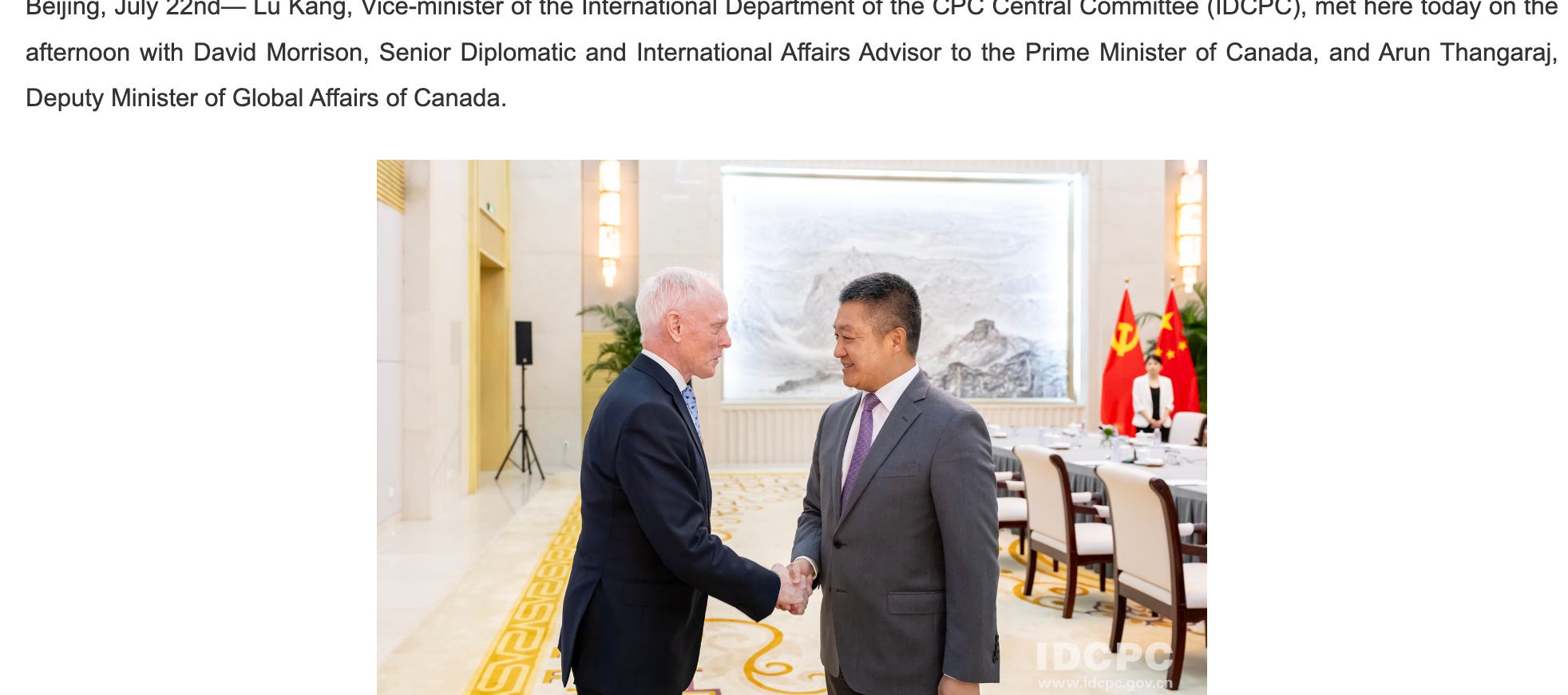
Two days before Zhang’s arrest, Morrison was in Beijing. On July 22, he and Arun Thangaraj, Global Affairs Canada’s current deputy minister, met Lu Kang, a vice minister of the International Department of the Chinese Communist Party’s Central Committee, according to a readout published by the party department.
In the readout, Lu said China-Canada relations had “turned around and continued to improve” under the guidance of the two countries’ leaders, and that China stood ready to promote “a new strategic partnership.” His department, he said, was willing to strengthen communication and exchanges with “Canada’s major political parties to enhance mutual understanding and trust.”
The Canadian side, according to the readout, said exchanges had made positive progress since Carney’s visit to China in January, and that the two countries should strengthen coordination on issues including trade, energy, climate change, artificial intelligence and transnational crime.
Zhang was arrested by Belgian federal police on July 24 on suspicion of espionage on behalf of a third country and participation in a criminal organization, charges carrying up to 15 years if proven.
