

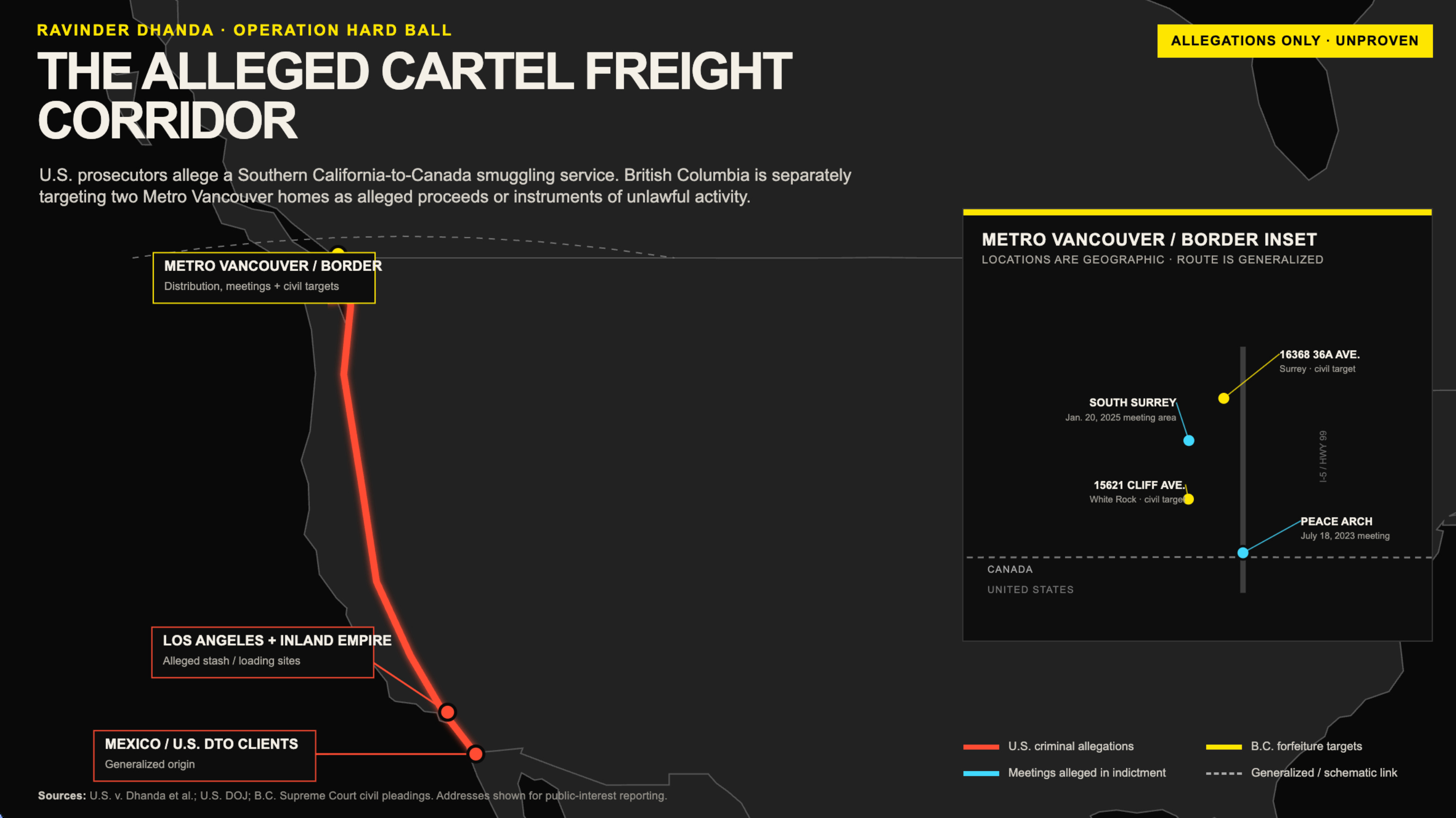
VANCOUVER — Ravinder Singh Dhanda, the Vancouver trucking businessman accused by a Los Angeles grand jury of operating an industrial cocaine-and-methamphetamine pipeline across Canada’s border, has now answered British Columbia’s attempt to seize two of his family’s homes.
The money behind the family real estate, Dhanda says, did not come from drugs.
It came, Dhanda says, from trucking income, Lower Mainland property deals, a heavily financed car wash that burned to the ground, the insurance payout and eventual land-sale profit, and a line of credit secured against the family home.
Dhanda was arrested in July as one of the central Canadian targets of Operation Hard Ball, the FBI-RCMP investigation that produced three U.S. indictments against 37 defendants linked to India-based transnational organized crime.
In Dhanda’s case, prosecutors allege his network sold bulk transportation and smuggling services to drug organizations in the United States, Mexico and elsewhere, moving hundreds of kilograms of cocaine and methamphetamine into Canada each week.
The indictment alleges the network concealed narcotics inside legitimate commercial freight, used working farm trucks at the border, and obtained information about the timing and location of Canada Border Services Agency inspections from a person inside the agency.
In January 2025, at a South Surrey meeting monitored by law enforcement, Dhanda allegedly said he intended to form a new “cartel.”
But the province’s allegations, his response says, are “speculative, unsupported by any evidence, and false.”
He denies conspiring to control, coordinate, smuggle or distribute cocaine, methamphetamine or any other controlled substance. He denies benefiting from unlawful activity, belonging to a criminal organization or using either home for an unlawful purpose.
The filings open a Canadian legal contest over the wealth behind the man American prosecutors allege sat at the northern command of a cartel freight network: U.S.- and Mexico-based drug-trafficking organizations at one end; Los Angeles stash houses, long-haul trucking operators and an allegedly compromised Canadian border at the other.
All allegations in the American indictment and the provincial forfeiture claim remain unproven. Dhanda and his co-accused are presumed innocent.
Dhanda and his wife, Manjit Kaur Dhanda, filed separate responses in B.C. Supreme Court on October 5, opposing the Civil Forfeiture Director’s claim against 15621 Cliff Avenue in White Rock and 16368 36A Avenue in Surrey—properties assessed this year at approximately $3.6 million and $2.6 million, respectively.
The lawful income history for Dhanda’s real estate wealth begins in the 1990s, he says, when he owned and drove a dump truck. After a workplace injury, he moved into highway trucking and then established Blazer Transportation around 1999, operating company-owned and leased trucks until approximately 2007.
Dhanda says his extended family jointly bought a Surrey home in 1991. He sold his interest in 1997 and bought another home. The family acquired rental properties in Burnaby and Guildford in the mid-1990s, sold them around 2000, demolished a rental house on a Delta property and built a new family residence. They moved from Surrey to Delta in 2002 and sold the Surrey home.
In 2003, the family bought a lot on Morgan Avenue and built again. Savings from those transactions, income from Blazer and what Dhanda calls mostly profitable investments supplied capital for the ventures that followed.
The largest was a commercial property with a car wash and auto dealership, acquired in 2013 with substantial bank financing. The car wash burned down in 2016.