


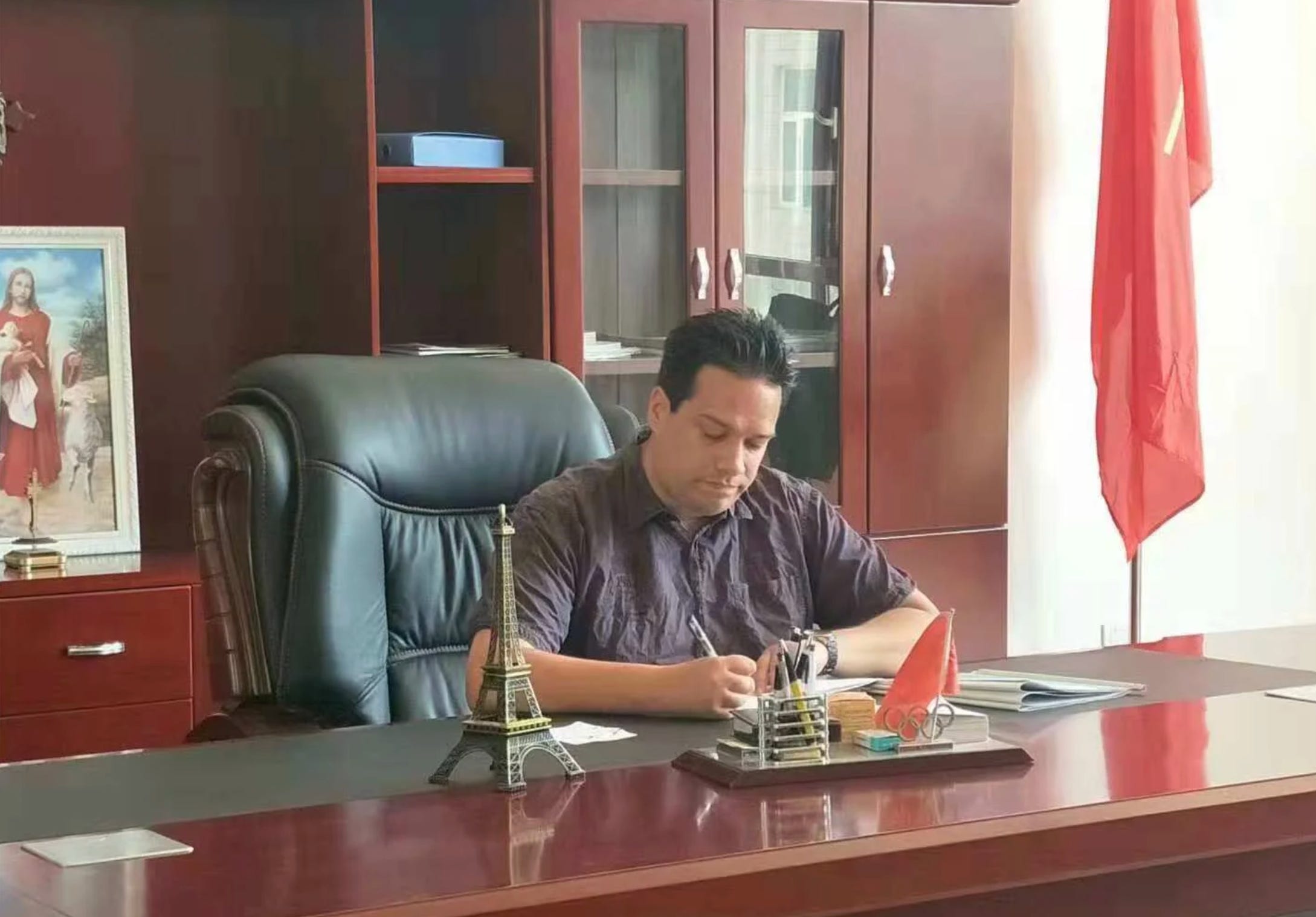
WASHINGTON — In 2017, as Donald Trump launched a campaign to decouple the United States from a system of economic entanglement with China that a generation of American officials had come to see as quietly corroding the nation’s security and wealth, the son of a Texas Republican was living in Beijing under a borrowed name — and, that year, was introduced to a man who, he came to understand, communicated frequently with Xi Jinping himself.
His name was Thomas Pauken II. To his audiences on Chinese state television, and on the masthead of the Chinese Communist Party’s official news agency, he was Tom McGregor — a pseudonym he later told the FBI he adopted at his father’s request, because the elder Thomas Pauken, a former Reagan administration official and onetime chairman of the Texas Republican Party, did not want his name attached to his son’s work for Beijing.
What followed, according to allegations laid out in an FBI counterintelligence affidavit unsealed this month in the Eastern District of Virginia, sketches a portrait of espionage and information warfare in which the line between Chinese journalist and Chinese intelligence asset disappears — a system in which not only Chinese media are forced to spy for Beijing, but foreigners hired to perform the work of state journalism are tasked, polygraphed, paid, and ultimately turned into recruiters reaching back into Washington.
While working openly as a Chinese state-media commentator and, later, a Xinhua editor, Pauken was handled by a succession of state security operatives, subjected to a lie detector test to prove he was not a CIA spy, tasked with cultivating a U.S. government employee for recruitment, paid roughly $100,000 for reports he was told were read by Xi Jinping himself, and — by his own account to the FBI — asked to apply for a job at the U.S. State Department and report back on his progress. What emerges from the affidavit is less the story of a single agent than the anatomy of a method.
The man Thomas Pauken met in 2017, it turned out, was a speechwriter for Xi Jinping, the General Secretary of the Chinese Communist Party — a writer of the words the Chinese leader spoke to the world, who in the FBI’s account communicates regularly with Xi himself. It is a striking image: an American, the son of a Reagan official, drawn into the orbit of the man who helped shape the utterances of the most powerful figure in China, at the precise moment two superpowers were tearing at the seams of global trade.
And it was the speechwriter, the affidavit states, who introduced Pauken to a Chinese woman he knew only as “Cathy,” whom he was told consulted for a think tank tied to the Chinese government. Cathy, the affidavit alleges, was an officer of the Ministry of State Security, China’s premier civilian intelligence service.
For the next several years, according to the FBI, Pauken operated as what counterintelligence officers call a cut-out: a non-professional collector who recruits, services, and reports on human sources on behalf of trained intelligence officers. He carried taskings into the United States. He met with prospective sources, handed them encrypted devices, relayed Beijing’s questions, and carried their answers back. He was paid, the affidavit alleges, roughly $100,000 for his reports, plus thousands of dollars more per trip — money Cathy often wired to his wife’s bank accounts in China. Cathy told him, repeatedly, that his reports were read by Xi Jinping.
In 2022 or 2023, the affidavit alleges, Cathy administered what Pauken understood to be a polygraph. The roughly ten yes-or-no questions included whether he was spying against China, and whether he worked for the CIA.
Pauken’s own account did not stop with Cathy.
He described to the FBI reporting for two contacts in China he called Richard and William, met during the 2017 trade conflict, who told him his reports went to Japan but whom he believed worked for the Chinese government, and who asked him to apply to the U.S. State Department and report on his progress.
He described earlier clients from Wuhan, interested in technology and the U.S. Department of Justice, who he said wanted him to find an expert to help them conduct cyber espionage, and whose point of contact, he stated, worked for state security. The Wuhan clients, by Pauken’s telling, were not after commentary or analysis at all; they wanted him to locate an American technical expert who could help them carry out cyber intrusions.
Pauken’s cover was not invented; it was his actual career.
Born in 1975, a heavyset man of five feet ten inches and some 250 pounds, he listed a single employer on his federal charging sheet: Xinhua News.
Beginning around 2010, he worked as a journalist in Hong Kong, then for China Radio International, China Central Television, and China Global Television Network, before becoming an editor in March 2024 for Xinhua, the official news agency of the Chinese state and a flagship organ of the Communist Party’s vast propaganda and information apparatus — a ministry-level institution of China’s State Council, the country’s highest administrative body. The press credential was not a disguise draped over an operation. It was the operation.
There is an irony in Pauken’s biography, that resonates with current events in Canada. In 2019, under his own name, he published a book on the very confrontation that had drawn him into Cathy’s orbit. Its title was US Vs China: From Trade War to Reciprocal Deal.
In January 2026, Prime Minister Mark Carney traveled to Beijing — the first visit to China by a Canadian prime minister since 2017 — and emerged with what his office called a new strategic partnership spanning trade, energy, law enforcement, and media. Among its components was an agreement, welcomed in the Prime Minister’s own readout, between Destination Canada and China Media Group, the Chinese Communist Party’s central state broadcasting and propaganda apparatus, to provide what the broader arrangement framed as mutual support and convenience for media to operate in each other’s countries.
The premise of such an arrangement is reciprocity and building bridges. Canadian media gain access to China, Chinese media gain access to Canada.
But the Pauken affidavit is a documented account of what the Chinese half of that exchange can look like in practice — of how a state media credential functions as an intelligence platform, and of how the personnel of China Media Group’s sister institutions have been deployed not merely to report but to collect, to cultivate, and to recruit. The U.S. government, moving to keep Pauken behind bars, put the duality in a single sentence. He splits his time, prosecutors wrote, working for China’s state news agency and China’s intelligence services.
A different sort of ambiguity was, for years, presented in the image Pauken cultivated. In podcast appearances and interviews promoting his work, he presented himself under the McGregor name as a widely read China journalist from Dallas living in Beijing — a man who was, in the words of one host’s introduction, “both very pro-Trump AND pro-China.” A trusted media voice that narrows the distance, an affable bridge-builder.
Political Consultant Seeking Trump Admin Job
The figure at the center of the alleged recruitment effort is identified in the affidavit only as Person 1 — a political consultant Pauken met at a Washington event in June 2023, who was at the time seeking a position in the incoming Trump administration and now, according to a footnote, works for a U.S. government agency.