A New Era in Canada–China Relations, or an Arctic Bargain?
Op-Ed: Canada has what Beijing wants most. A credible route to Arctic nation status. Is Mark Carney ready to bargain?
By Patricia Adams and Lawrence Solomon
OTTAWA — Canada has only one thing that Chinese President Xi desperately needs that he hasn’t been able to get elsewhere: a path to Arctic nation status. China has only one thing Canadian Prime Minister Mark Carney desperately needs that he can’t get elsewhere: a trade pact large enough to make credible his vow to pivot away from Canada’s dependence on the United States.
The two leaders did discuss the Arctic when they met in January in Beijing and arrived at “much alignment of views,” as Carney put it. But unlike the details announced on the two countries’ many trade talks, and their MOUs on energy, crime, cultural partnerships, wood products, multilateralism, media cooperation, and food safety, the countries were silent on what they were up to on the Arctic. If they arrived at an agreement, they are keeping it under wraps.
We do know that their alignment on Arctic matters was framed as part of a “new era” in Canada–China relations and a “new world order” that emphasized pragmatic cooperation. Given President Donald Trump’s determination to keep China at bay, and his apparent success at kiboshing any foothold China hoped to establish in Greenland, Carney and Xi would have an understandable interest in flying below the radar.
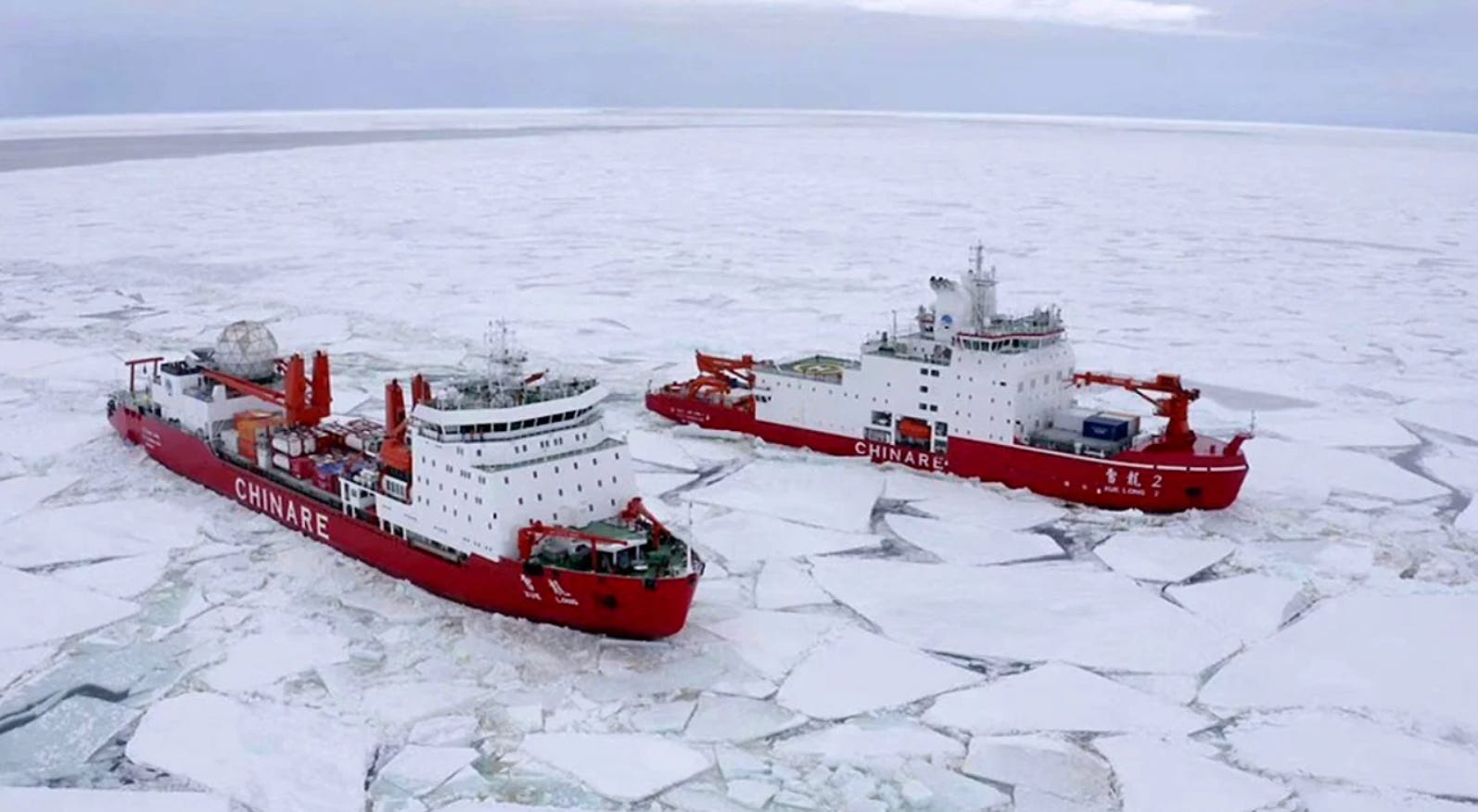
For China to claim status as an Arctic nation, rather than the “Near-Arctic State” status that it invented in 2018, it would need to be seen as an owner. Merely having mining operations—as Chinese companies do in Canada’s Arctic—or research stations, as China does in Norway’s and Iceland’s Arctic, or access to Arctic shipping lanes, as it has exercised for more than a decade—falls short of providing China with the full-throated Arctic nation status it has long sought.
China, whose ambitions in Canada’s Arctic are well-documented, operates on multiple levels. It openly negotiates with governments to secure northern resource concessions while, according to Canadian Security Intelligence Service, it has been quietly cultivating relationships with Canadian First Nations leaders whose support could steer those concessions to China.
An unredacted 2019 National Security and Intelligence Committee of Parliamentarians report revealed that China invited Aboriginal leaders on what was advertised as a tourism junket to China, but which a PRC embassy official privately admitted was “beipian” (Mandarin for “to be fooled”)—the true purpose being to pursue Aboriginal-controlled natural resources.
Chinese intelligence conducted research on each delegate to identify his “potential usefulness” to the PRC. As one Chinese official noted with apparent satisfaction: “Chiefs are ‘blind’ when dealing with the PRC and have no interest in knowing more.”
What tactics might China employ to secure the Arctic foothold it seeks?
History offers several precedents. China could pursue 99-year leases to Arctic islands or territories, much as Britain held a 99-year lease to Hong Kong. It could seek to construct artificial islands in Arctic waterways, as it has done with great success in the East China Sea. Or it could negotiate outright purchases of Arctic land or islands—options that have been under discussion elsewhere, including Greenland and, to a lesser extent, the British-owned Chagos Islands in the Indian Ocean.
Whether any such arrangements are being discussed between Ottawa and Beijing remains unknown. The silence surrounding the Arctic component of Carney and Xi Jinping’s “much alignment of views” is itself concerning.
Given China’s documented pattern of patient, multi-level infiltration, and a history of Liberal prime ministers willing to alter the world order in favour of Beijing—as Pierre Trudeau did in 1970 by recognizing the People’s Republic over Taiwan—Canadians deserve transparency about what commitments, if any, their government is considering.
Patricia Adams is executive director of Probe International, a Toronto-based China watchdog. Lawrence Solomon is a founding columnist with FP Comment.


If Carney did underhanded deals that gave China access to the arctic I gotta believe that would be the last straw for Trump and Canada’s relations with the US. I’d imagine the tariff rates would go to crushing the Canadian economy. The NAFTA would be dead and American companies would be begin pulling out too. Canada looking to get millions from American car companies looks like a grift coming straight from the EU like they fine US tech companies. If Canada wants to FAFO it won’t end well. That I can guarantee.
"Given China’s documented pattern of patient, multi-level infiltration, and a history of Liberal prime ministers willing to alter the world order in favour of Beijing—as Pierre Trudeau did in 1970 by recognizing the People’s Republic over Taiwan—Canadians deserve transparency about what commitments, if any, their government is considering."
It seems what most Canadians want and what they get from this leader of Canada and his red scarf team are two very different things. We all know Trump is on full alert with the matter of China and Canada. Taking pot shots at Trump during DAVOS is one thing - playing games with "a path to Arctic Nation status" is a whole other thing.