


VANCOUVER — For weeks this winter, the company that operates a coal terminal in the Port of Vancouver believed it was paying millions to the contractor building its new potash export facility. Like many elderly victims across North America taken in by spoofed emails and phantom investment deals, Westshore Terminals had been scammed.
According to a sprawling file in the Supreme Court of British Columbia reviewed by The Bureau, Westshore alleges the $6.2 million was going instead to a numbered company registered at a PostNet store that rents mailboxes in Markham, Ontario. Company records list its director as Jiaying Liu, a person whose identity Westshore’s lawyers told the court they were still trying to establish.
The victim, a pillar of Canada’s resource export economy, is no ordinary company.
Westshore operates the largest coal-loading facility on the west coast of the Americas, shipping Canadian and American coal to steelmakers and power plants in Asia. It is also building a terminal, funded by BHP with an initial $1 billion, that will carry potash, the crop nutrient on which much of the world’s food supply depends, from the mining giant’s mine in Saskatchewan to overseas markets, due for completion in 2027.
Westshore Terminals is affiliated with Westshore Terminals Investment Corp., in which British Columbia billionaire Jim Pattison held about 47 percent of the shares, according to the company’s May 2025 management information circular.
The fraudsters, the lawsuit alleges, intercepted payments owed to the Westshore construction contractor building its potash shipping infrastructure.
What Westshore uncovered as it forced Canadian banks to open their records is laid out in hundreds of pages of filings reviewed by The Bureau.
The filings trace the money through seven numbered companies, a Calgary bullion dealer and personal accounts at all five of Canada's largest banks, held by more than 20 people with Chinese names, and to a string of addresses across the Toronto suburbs of Markham, Scarborough, Richmond Hill and North York.
The structure they describe closely matches the Chinese professional money laundering methods that Canada’s financial intelligence agency described in a 2023 alert on underground banking networks tied to China and Hong Kong, and it points toward global money movements far larger than one fraud.
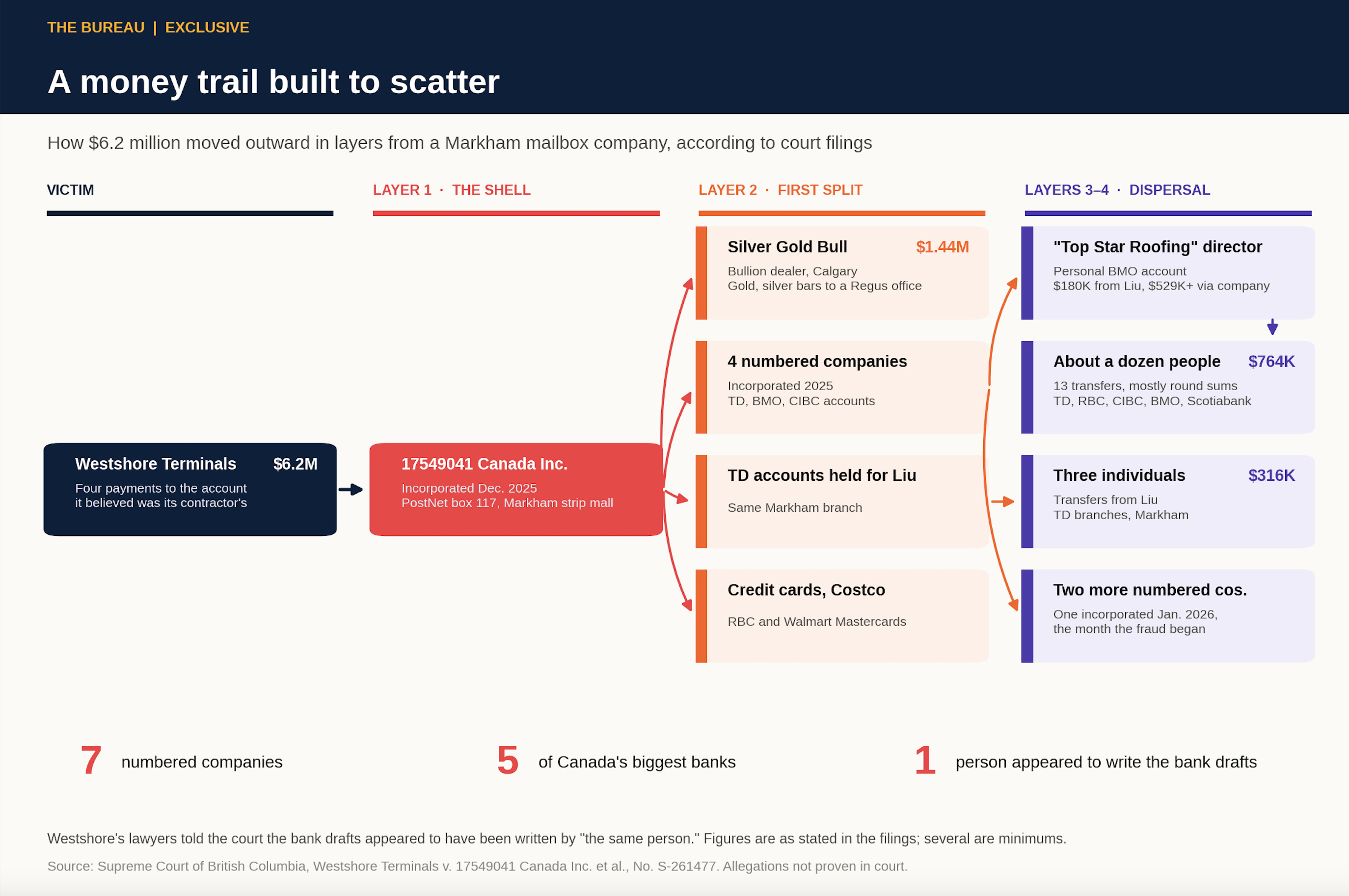
Westshore alleges that fraudsters impersonating employees of its contractor, Kingston Construction Ltd., diverted $6,218,200 into a TD Bank account in Markham held by 17549041 Canada Inc., a federal numbered company incorporated in December 2025.
The claim describes Jiaying Liu as the company’s “director and controlling mind.” The scheme itself was simple, but appears to have employed significant cyber-scam capabilities.
In January, Westshore began receiving messages from addresses that closely resembled those of its contractor, but the fakes added a single letter to the email address.
Westshore “did not notice that the email addresses were slightly different,” its lawyers told the court.
The messages said Kingston had changed its banking details.
They claimed Kingston was not receiving Westshore’s emails, a ruse that let the senders bypass Westshore’s usual system for updating payment details.
And they supplied a TD account number.
At the same time, the claim alleges, fake addresses in the names of Westshore employees were used to intercept communications with Kingston, so the two companies would not compare notes.
Between January 26 and February 12, Westshore sent four payments.
When its bank called to verify them on February 18, the senders were already steering future payments to a new account at Scotiabank. Westshore discovered the fraud the next day and reported it to the Delta Police Department.
What followed reads less like a collections case than a detective story.
Court orders obtained by Westshore’s lawyers forced TD, and then four more of Canada’s biggest banks, to open their records.
What those records showed was a money network shaped like a river delta, or what auditors might call a “flow-through” structure: one large stream in, and smaller channels branching out in every direction.
Funds transferred into the TD account registered to a Markham strip mall postal box quickly scattered out to many different accounts held by different companies and people under more than a dozen Chinese names.
By early March, less than $500,000 remained in the account.
About $1.44 million had gone to Silver Gold Bull Inc., a Calgary bullion dealer. Some had been spent on credit cards and at Costco.
The rest had moved by cheque and bank draft into four Ontario numbered companies, all incorporated in 2025.
From there it flowed into the personal accounts of their directors and others, at TD, the Royal Bank of Canada, the Canadian Imperial Bank of Commerce, the Bank of Montreal and Scotiabank, in branches across Markham, Scarborough, Richmond Hill and North York.
The account had also received small deposits on January 14 and 20, before the fraud began, from another account at the same branch that “may be connected to the defendants.”
The bullion dealer and the banks are not accused of wrongdoing.
None of Westshore’s allegations have been proven in court.
The alleged Westshore fraud scheme ran under a construction front, resembling a U.S. federal case The Bureau reported in August from Orlando, Florida.
There, prosecutors allege, a cell of Chinese nationals used newly registered companies with builders’ names, but no permits, payroll or construction materials, to collect elderly victims’ savings and wire them to banks in Hong Kong.
A 2019 fraud against the City of Saskatoon ran much the same way.
Someone impersonating the chief financial officer of Allan Construction, a city contractor, emailed staff new banking details and redirected about $1.04 million. Within days an Ontario judge froze money in several bank accounts, and the city recovered its funds. The Bureau traced some network actors into an apparent web of bank accounts and currency traders in Toronto.
Follow one artery from the bank account registered to the Markham mailbox, and it splits again, into veins and then capillaries.