

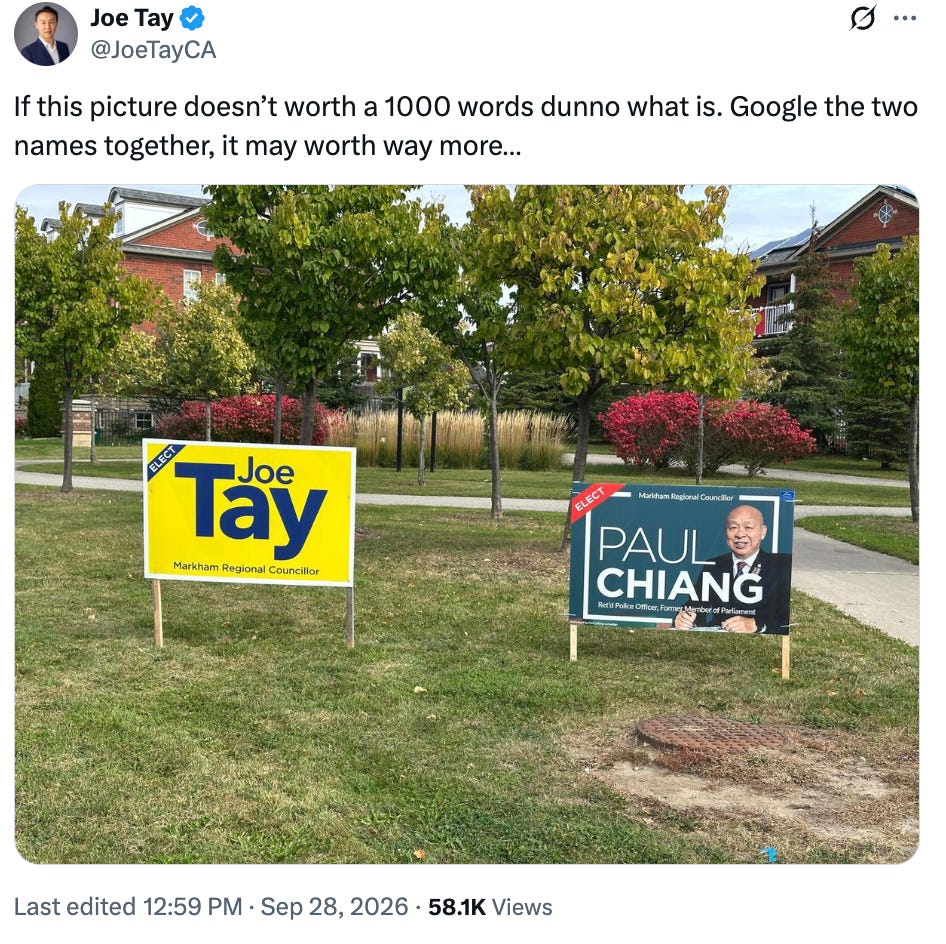
MARKHAM, Ontario — Joe Tay reacted viscerally when a campaign volunteer sent him the photograph last week. On a strip of grass beside his yellow placard for Markham regional councillor stood a dark blue sign for Paul Chiang, the retired police officer and former Liberal member of Parliament who quit the 2025 federal election after suggesting to Chinese-language journalists, gathered in his constituency office in Markham–Unionville, that Tay be handed to China’s consulate in Toronto for a Hong Kong bounty.
Even though no one stood in that photo, just two signs, side by side, Tay said a chill ran down his spine.
“All these memories almost came back instantly on everything,” Tay said in an interview this week with The Bureau. “It’s very emotional.”
The memory that flashed back first, like a trauma, was from March 24, 2025, the day after the federal election was called.
That day, Tay and his wife, Angie, were on a video call with officials from Public Safety Canada, Global Affairs Canada and the Royal Canadian Mounted Police. From the corner of his eye, Tay saw two uniformed officers walk into his backyard without an appointment and knock on the door. They asked him to step outside.
Tay assumed there had been a mix-up. “Maybe I’m actually talking to one of your colleagues online,” he recalled telling them. The officers were Mounties. They insisted, and asked him again to step outside. They told the couple they had “received from their own credible source that someone is going to harm me,” Tay said.
“At that time, my mind went completely blank,” he recalled. His second question was about the rest of the household: “Is it just me or my family?”
Tay had become the Conservative candidate for Don Valley North on March 23. Canada’s election-security task force later found that posts attacking his candidacy appeared en masse on Chinese-language platforms March 24 and 25, apparently timed to the announcement. One asked: “Is Canada about to become a fugitive’s paradise?”
The task force tied the campaign to the People’s Republic of China, which it said was working to suppress Tay’s visibility to Chinese-speaking voters.
For Tay, it had all started three months earlier.
In Canada for about 25 years, he watched as the jurisdiction of his birth, Hong Kong, now effectively under Chinese Communist Party control, reached into Canada, in his view, to silence him.
Hong Kong’s national security police had put a bounty of HK$1 million, about $180,000 Canadian, on Tay, a Canadian citizen and former Hong Kong entertainer who runs a pro-democracy channel from the Toronto area.
In an interview lasting more than an hour, Tay described to The Bureau extraordinary circumstances surrounding his last federal campaign that remain unresolved, and what he sees as his struggle not only to heal from the ordeal, but to reclaim the democratic rights he believes Canada failed to protect.
Now, in a municipal election concluding Oct. 26, Tay is running against the man he believes not only damaged his political prospects in 2025, but helped expose him to real danger that changed his life.
Chiang’s remarks, Tay said, put “any Canadian, it happens to be me, in harms way.”
Chiang did not respond to detailed questions sent to his campaign for this story.
Chiang made the remarks on Jan. 21, 2025, in his own federal constituency office.
Ming Pao reported them the next day, but they did not reach English-language media until late March, when the Toronto Association for Democracy in China flagged them to reporters on the campaign trail. Once The Bureau and other outlets reported the comments, Chiang apologized, calling them “deplorable.” Tay rejected the apology.
Prime Minister Mark Carney stood by his candidate.
On March 31, a week into the campaign, Carney called the remarks “deeply offensive” but kept Chiang on the ballot, citing his apology and long police career.
He called the episode “a teachable moment.” Thirteen Hong Kong–Canadian groups demanded Chiang’s removal, and Hong Kong Watch, a British human rights group, wrote to Mike Duheme, commissioner of the Mounties, asking for a criminal investigation. That evening, the force said it was “looking into the matter.” Just after midnight, Chiang stepped aside. Carney said only that he had accepted the resignation.
Tay later told a House of Commons committee in December 2025 testimony that the episode had frightened him most when the prime minister defended Chiang.
“When Mark Carney was protecting the candidate, that really scared me,” he said.
The Liberals replaced Chiang with another former police officer, Peter Yuen, a retired Toronto police deputy chief. The Bureau reported that Yuen had joined the board of a Chinese international school in Markham that was flagged in inquiry testimony on foreign interference in a neighboring riding in 2019, and that in 2017 he attended a gala hosted by the Confederation of Toronto Chinese Canadian Organizations, a group with direct ties to the Chinese consulate and Beijing’s United Front Work Department.
The Globe and Mail reported that in September 2015, Yuen accepted an invitation from China to join about 70 Chinese Canadians in Tiananmen Square for the 70th anniversary of the People’s Liberation Army’s victory over Japan. Yuen lost Markham–Unionville to Conservative Michael Ma.
Ma did not stay a Conservative.
In December 2025, he crossed the floor to Carney’s Liberals, and in January he joined the prime minister’s trip to Beijing. In March, at a House of Commons committee examining Carney’s decision to slash tariffs on Chinese electric vehicles, Ma pressed Margaret McCuaig-Johnston, a senior fellow at the University of Ottawa, on whether she had personally witnessed forced labor, and suggested her evidence was “hearsay.” He apologized later.
This is the political landscape of Markham that Tay has decided to step back into.
After his federal election defeat, Tay withdrew from public life, staying “quiet, flying under the radar just to get myself together because what I’ve been through in my family.”
Amid “a long process of healing myself and my wife together,” he said, he found the courage to try again, encouraged by a small circle of friends who had been with the couple through all of it. Markham has been home to three generations of his family for 25 years.
The Bureau put it to Tay that he was giving himself, and Canadian democracy, another chance.
He answered in his own terms.
“We want to take back the control instead of being fearful,” he said. “I want to run as just like any other candidate. I will have my own knocking on doors, canvassing, talk to volunteers, drop off the lawn signs.”
“We have to be conquering fear by facing the fear,” he said.
“Then I saw the (Paul Chiang) sign still standing up as if nothing had happened,” Tay said of the photograph. “That scares me the most.”
Angie Tay looked at the same picture and told her husband to take care of his security, he said, “because nobody knows about this. Seems to be nobody did any investigation.”
The RCMP file Tay knows was opened in March 2025 remains unresolved, he says.
“There is never an update since last federal election till now,” Tay said. He has emailed asking for news of the file and received no reply “a couple times.” Federal agencies still make unscheduled visits, he said; the most recent was a few weeks ago.
Asked whether Canada, and the RCMP, did enough to give him a fair election, Tay said its response was “far from adequate.” Agencies warned him when they detected a threat, he said. “And that’s about all, right?”
Tay is careful about what he does not know, in regard to Paul Chiang’s connection to the RCMP file.
“Well, let’s be fair, is the individual already been exonerated?” he said. “If so, I would like to know the report on that, and why (Chiang) is exonerated.”
“The case already has opened, the file number has been there,” Tay said. “We should have the right to know what happened.”
The Bureau asked the federal police on Thursday about the status of the file, whether Tay or Chiang had been interviewed, why Tay has received no update, and whether any update will be made public before the vote. The force has not yet responded. The Bureau will update this story if it does.
On April 21, 2025, the federal task force monitoring threats to elections publicly identified Tay as the target of a coordinated transnational repression operation on platforms including WeChat, Facebook and TikTok. That same day, Tay paused in-person campaigning on the advice of federal police, The Bureau reported the following day, citing two sources.
In the race’s final days, The Bureau also reported that Tay’s campaign had alerted police to a man allegedly following one of its door-knocking teams in a threatening manner. Police were reviewing complaints that canvassers were being shadowed. The Bureau examined photographs of the unidentified man taken by campaign members. “I have never seen this picture,” Tay said when asked about the images.
The New York Times later reported that Tay had waged “perhaps the quietest campaign of any candidate competing in the election.”
Yet in more than an hour of conversation with The Bureau, Tay never once mentioned Chiang by name.
He described the strange encounters at Markham election forums, where the two men now appear as rival candidates, but the events that brought them international attention in 2025 go unaddressed. Chiang speaks of his decades in policing and public service, Tay said, while neither man publicly confronts the controversy that ended Chiang’s federal candidacy.
For now, Tay says he wants to leave that confrontation behind. He has not approached Chiang about the remarks during the municipal campaign, preferring to focus on his own recovery, his return to politics and the concerns of Markham voters.
But that does not mean he considers the matter settled.
Tay still questions why Chiang, a former police officer and sitting member of Parliament, would suggest delivering a Canadian citizen to a foreign consulate for a bounty that Ottawa had already condemned. He also wonders why Chiang has not publicly clarified the basis for linking the Chinese consulate to the reward, and why the consulate itself has not publicly addressed the suggestion that Tay could be brought there to collect it.
“It’s no joke,” Tay said of Chiang’s remarks.
He noted that Chiang, as a parliamentarian, would have been aware of Canada’s official condemnation of the Hong Kong bounty.
“I always wonder, has anyone asked him, ‘Do you condemn transnational repression? Because as an MP, you should.’”
The room where Chiang uttered the remarks seems significant. His own constituency office. The people in the room could matter too. In an October 2022 assessment marked secret and obtained by The Bureau, the Canadian Security Intelligence Service described a “takeover” of Chinese-language media in Canada by the People’s Republic of China. It assessed that roughly 30 to 40 people in the Greater Toronto Area act as “gatekeepers to ensure that whatever is reported in Chinese-language media adheres to pro-PRC narratives.” A 2019 report by the National Security and Intelligence Committee of Parliamentarians, reported by The Bureau in 2023, found that Chinese officials had used tactics in Canada including “paying Chinese-language journalists to locate and track individuals.” Both documents predate the January 2025 meeting, and neither refers to anyone who attended it.
Tay knows the Chinese-language media world from the inside.
He spent about a decade in Chinese-language broadcasting beginning in the mid-2000s. During the Hong Kong democracy movement, he said, staff received orders from the top of the organization “not to report on something or try to downplay certain factual occurrence.” Since he entered politics, he says, the same media organization he used to be familiar with has not invited him on air once, while other candidates appear regularly. He would not speculate about individual reporters in Chiang’s office that day.
“I would not have proof, but I would say this is highly plausible,” he said of the possibility that the January 2025 “bounty” remarks in Chiang’s constituency office served a coordinated purpose.
On Thursday, the Chinese Media Professionals Association (Toronto) held “2026 Municipal Election: Candidates Meet with Chinese Media,” according to a poster for the event.
Candidates were offered one to two minutes to introduce themselves, followed by questions from reporters, with registration on a first-come basis. Tay said he was not invited and was never informed of the event, learning of it only through an acquaintance. A photograph of the event shows Paul Chiang seated among the other candidates, his fist raised.
The event was held at the Markham media center of Canada Global Chinese Television, a Mandarin-language broadcaster whose app listing describes its main task as promoting China’s image.
After two RCMP officers warned him of a threat to his safety in March 2025, the rest of Tay’s federal campaign, in Don Valley North, ran under security constraints. “Even my volunteers got canceled sometimes because of the risk assessment,” he said.
Tay ultimately lost Don Valley North to Liberal Maggie Chi, taking 42.3 percent of the vote, against Chi’s 53.2 percent.
The cost did not end on election night, he says. On May 8, 2025, Hong Kong police brought in Tay’s cousin and the cousin’s wife for questioning in the case against him. Tay said Hong Kong authorities also generated what he described as tax-evasion reports targeting his wife.
Angie Tay’s mother left Hong Kong after the bounty and the Chiang remarks and has sought asylum in Canada. Because she first entered Canada in 2021, Tay said, his mother-in-law may be affected by a new asylum eligibility restriction that generally prevents claims made more than a year after first entry from being referred to the Immigration and Refugee Board. Tay fears she could face removal.
“So this is how serious a joke can lead us, the whole family, with no solution in sight,” he said.
In Markham, the effect was isolation. “Then you start to lose your friends,” Tay said. Supporters tell him, “Oh, we’ll support you in whatever way, but we can’t afford to take a picture with you. You would understand.”
“You lost a lot of emotional support, friendships and trust, and you have to carry your smear,” he said.
At fundraisers, he said, the group picture is often “just me and my wife and a handful of friends that have decided not to go back to Hong Kong. Then what would that picture tells us? Oh, Joe Tay is not welcome.”
On the doorsteps of Markham this fall, he said, some residents welcome him and then remember. “Oh, this is the guy who is tied with a certain serious matter,” he recalled. “Then suddenly, ‘Oh, sorry. Let me think about it.’” Some close the door, and some refuse a lawn sign.
Tay says Chiang, whose sign describes him as a “Ret’d Police Officer, Former Member of Parliament,” has not acknowledged what happened in 2025. Hearing him introduced as the right candidate for the job, Tay said, is hard to sit through.
“I think voters deserve a clarity,” he said. “They deserve to have full knowledge of what is the representative background.”
In questions sent Thursday, The Bureau asked Chiang whether he retracts the suggestion that Tay could be taken to the consulate, and whether he condemns Hong Kong’s bounty and China’s transnational repression of people in Canada. It also asked who organized the January 2025 meeting with reporters, whether he has been interviewed by the federal police or told the outcome of their file, and why he has not raised the events of 2025 with voters in this campaign. He did not respond.
Tay said he does not know whether foreign influence is at work in this race. “I don’t have proof that there are other interference,” he said. He has noticed that some opponents’ mailings to residents appear to be three or four times the volume of his own, at a cost he estimates at $20,000 to $30,000 for a single mailing to every household. He said fear has kept some would-be donors from giving openly. Candidates’ financial statements will not be filed until next year.
Tay says he will make up the difference in effort. For the past two months, he said, he has been “very active every day, exhausted from campaign,” and he promises to treat the council seat “as if you have a full-time job.”
He wants more police officers for the region, which he says has about 140 officers per 100,000 residents against a provincial average of 175 to 185. He wants more youth mental-health services, saying a young person in York Region can wait 900 days for counseling that is available in Vaughan within months. He also wants smart traffic signals and better coordination between GO trains and buses. He has promised to answer residents within 24 hours, with a timeline for follow-up.
“All this previous experience has led me to this position that I can identify and relate to different individuals when they are feeling so helpless,” he said. “And that kind of fear and sometimes isolation is always there.”
Asked what he wanted voters to take from the interview, Tay returned to the photograph of two campaign signs that sent a chill down his spine, and the instruction he had posted with it.
He shared the image on Sept. 28 without naming Paul Chiang, writing that if the picture wasn’t worth a thousand words, he didn’t know what was, and that readers who searched the two names together might find it was worth far more. On the morning of Oct. 9, the post had been viewed 58,100 times.
In the interview, he extended that advice to every name on the ballot, “not just this two, including me.” “We will have to look for transparency and honesty of each and every candidate,” he said. A municipal race, he added, deserves the same scrutiny as a federal one: “even though it’s a municipality election, always study your candidates in the most length you can invest in.”
Even in his last words to The Bureau, Tay did not say his opponent’s name. “I would urge all voters to look at the background or Google the names together and try to see if they have crossed path.”
Timeline
Dec. 24, 2024 (Dec. 23 in Canada): Hong Kong’s national security police issue an arrest warrant for Tay, a Canadian citizen, with a bounty of HK$1 million, about $180,000 Canadian. Ottawa condemns the warrants.
Jan. 21, 2025: At a meeting with Chinese-language media in his Markham–Unionville constituency office, Liberal member of Parliament Paul Chiang says attendees could claim the bounty by bringing Tay to the Chinese consulate in Toronto. Tay is then seeking the Conservative nomination in the riding.
Jan. 22, 2025: Ming Pao reports Chiang’s remarks.
March 23, 2025: The federal election is called. The Conservative Party names Tay its candidate in Don Valley North.
March 24, 2025: The federal election-threats task force later finds that hostile posts about Tay appeared en masse on Chinese-language platforms that day and the next. That day, federal police officers arrive unannounced at Tay’s home and warn him of a credible threat to his safety while he and his wife are on a video call with Public Safety Canada, the Royal Canadian Mounted Police and Global Affairs Canada.
March 28, 2025: Chiang’s remarks become national news. He apologizes, calling them “deplorable.” Tay rejects the apology and says he had sought police protection before the remarks surfaced.
March 31, 2025: Prime Minister Mark Carney keeps Chiang as the Liberal candidate, calling the remarks “deeply offensive” and the episode “a teachable moment.” Hong Kong Watch asks the federal police commissioner for a criminal investigation, and the Privy Council Office cites the bounty on Tay as an example of transnational repression. That evening, the Mounties confirm they are “looking into the matter.”
April 1, 2025: Just after midnight, Chiang steps aside as a candidate, and Carney accepts his resignation. The Liberals later name Peter Yuen as their candidate in Markham–Unionville.
April 21, 2025: The federal election-threats task force publicly identifies a transnational repression operation targeting Tay. Tay pauses in-person campaigning on the advice of federal police, The Bureau reports the next day.
April 28, 2025: Tay loses Don Valley North to Liberal Maggie Chi, with 42.3 percent of the vote to Chi’s 53.2 percent. Conservative Michael Ma defeats Yuen in Markham–Unionville.
May 8, 2025: Hong Kong police bring in Tay’s cousin and the cousin’s wife for questioning.
December 2025: Tay testifies before a House of Commons committee about intimidation during his campaign.
Dec. 11, 2025: Ma crosses the floor to the Liberals.
Since the 2025 election: Tay says he has received no update on the police file despite written requests. Federal agencies continue to make unscheduled visits.
August 2026: Tay and Chiang are both certified as candidates for Markham regional councillor.
Sept. 28, 2026: Tay posts a photograph of their campaign signs side by side.
Oct. 8, 2026: The Chinese Media Professionals Association (Toronto) holds a candidates’ event with Chinese-language media at the Markham media center of Canada Global Chinese Television. Chiang attends. Tay says he was not invited or informed of the event. The Bureau sends questions to the federal police and to Chiang. Neither had responded by publication.
Oct. 16–26, 2026: Voting in Markham’s municipal election.
That performance by Mr. Chiang was deeply disturbing and in my mind he should never be able to run for any position in any election in this supposed democracy. The CCP and their chosen candidate were not only interfering in the election, posing a threat to another candidate but made it unsafe for him to finish his campaign. The fact that Chiang can run again, regardless of his acts against democracy, is why Canada is a failed country. Not only have I lost any form of trust in our democratic system, I have lost any and all forms of trust with every Institution. It is time that Canadians start waking up to the grave injustices in our democracy (it’s not one any longer) and the blatant interference of foreign entities, their allowance to remain in the country, and the fact that the Liberal Government is so compromised and deviant, yet that remains mostly unknown to those who continue to vote for them. Either Canadian’s do not care, or have lost the ability to think further than the Corporate Media. What is even more frightening is these same Liberals are enacting laws very similar to China against their own citizen’s and yet they are allowed to remain in control over everything and every one. Canada is finished. Done.
How can this coercion be stopped. And WHY does the CCP have such a “hold” on Canadian politics. With no consequences or regulations.