

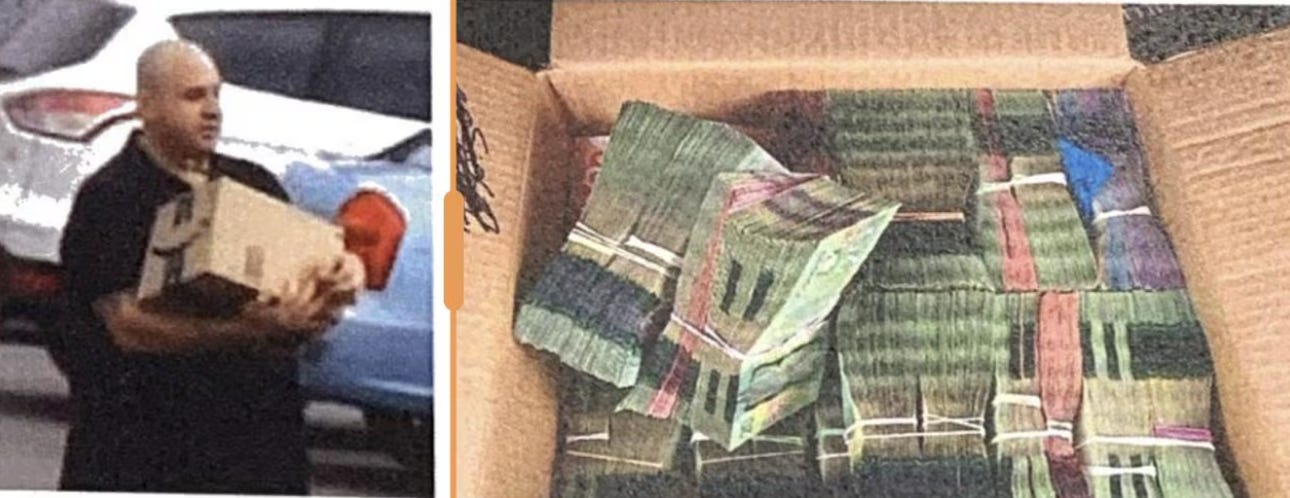
ALBERTA — The morning of August 18, 2022, in a quiet southwest Calgary subdivision, Nakita Baron, 31, stepped into the family’s Bentley beside her husband — a money launderer for Mexican cartels linked to Ryan Wedding’s massive cocaine importation pipeline.
Talal Fouani had been charged just two months earlier, in June 2022, as part of Project Cobra: Alberta’s largest drug bust, a sweeping federal investigation into a cross-border drug trafficking network tied to Chinese-supplied cartel labs that had flooded Canada with nearly one metric tonne of methamphetamine and six kilograms of cocaine, with a street value of $55 million.
As Fouani began to back the Bentley out of his driveway, a man in a construction vest approached and waved for him to roll down his window. Then he opened fire.
Nakita Baron was killed. Fouani was shot in the face and survived.
This week, a Calgary judge said he could not send Fouani to jail, sentencing him instead to house arrest — ruling that the cartel’s murder of his wife constituted sufficient punishment for his role in one of Alberta’s most significant organized crime investigations.
It is further corroboration of The Bureau‘s reporting on Canada’s broken legal system — the completion of a pattern of failures in the prosecution of Project Cobra and related cases involving the Sinaloa and Jalisco cartels and Ryan Wedding’s trafficking networks that, according to senior U.S. government sources, has allowed cartel violence to metastasize through Canada’s cities unopposed.
The decision closes the last active prosecution arising from Project Cobra. Every other principal target walked free without a conviction.
On Monday, Justice Greg Stirling of the Calgary Court of King’s Bench sentenced Fouani for laundering $800,000 in proceeds from drug trafficking — cash funnelled through a $3.575-million real estate purchase in Niagara-on-the-Lake, Ontario, on behalf of Ricco King, the alleged Calgary-based leader of the Project Cobra cell. As part of his guilty plea, Fouani also admitted to fabricating payroll records for King’s mortgage brokerage to make the proceeds of crime appear legitimate. The Bureau‘s sources connect the Cobra cell in Calgary to Ryan Wedding’s broader cartel-affiliated networks.
“I accept that Mr. Fouani suffered severe consequences subsequent to being charged with this offence,” Stirling said. The sentence — eight months of house arrest, eight months of curfew, and 180 hours of community service — means Fouani, who laundered money for Alberta’s largest cartel operation, will serve his time in his home.
U.S. and Canadian policing experts say the impact of ineffective courts has filtered into federal and provincial police decision-making, with major cases often neglected because the outcomes are anticipated before investigations begin.
Months before Monday’s decision, a senior U.S. government source who shared inside details on Project Cobra told The Bureau that the broader consequences of Canada’s legal and policing failures remain dangerously misunderstood by the Canadian public.
“This is the biggest threat facing Canada,” the official told The Bureau in September 2025. “We’ve been talking to RCMP for years about this, but nobody really wants to take it head on.”
Case Failure by Legal Attrition
The Bureau has previously reported in depth on the collapse of two of Canada’s most high-profile cartel prosecutions — Project Brisa in Ontario and Project Cobra in Alberta — and the structural legal failures that turned record-breaking seizures and triumphant press conferences into courtroom disasters, with all charges dropped, millions in taxpayer dollars wasted, and cartel networks left intact.
In both cases, two Canadian legal mechanisms — the Jordan decision, which imposes strict timelines on how long a prosecution can take before an accused’s Charter rights are violated, and the Stinchcombe ruling, which compels the Crown to disclose virtually all investigative materials to the defence — were leveraged tactically by defence counsel to collapse cases that had taken years and millions of dollars to build.
In Cobra, the Crown stayed all charges against the five main targets — including Ricco King himself — one day before defence lawyers were set to make a Jordan application, while simultaneously fighting a secret federal court battle over national security disclosure of sensitive RCMP investigative techniques. The moment the stays were issued, the Attorney General filed a notice of discontinuance on the federal proceedings, meaning the government would never have to reveal what it had been fighting to conceal.
The Stinchcombe-Jordan vice, as The Bureau previously reported, functions as a pressure mechanism that cartels and their lawyers have learned to exploit with precision — and that Canadian prosecutors and investigators have repeatedly failed to outmaneuver, while police leaders urge Ottawa to reform an outdated system unable to counter the sophistication and lethality of transnational criminals now overwhelming Canada’s institutions.
Fouani was, in the Crown’s own framing, among the least serious offenders charged in Project Cobra. The five targets police identified as the investigation’s core — alleged leader Ricco King, along with Elias Ade, Kary-Lynn Grant, Jarret Mackenzie and Abdul Akbar — saw every charge against them stayed in September 2024.
King had faced charges of drug trafficking, importation, money laundering and organized crime offences. It was the second time in five years he had walked away from international drug importation charges.
“Ricco King is another organized crime player that’s gotten away with everything he’s been charged with,” an Alberta police source with direct awareness of the Cobra investigation and U.S. enforcement frustrations alleged.
“I wish the public would ask the questions of why people like this can’t be prosecuted in Canada.”
Three others charged in the Cobra investigation pleaded guilty prior to the stays being issued. In April 2024, the Crown stayed charges against three more: Jesse Marshall, Daniel Menzul, and Sean Nesbitt. Fouani's own sister and brother — Lina El-Chammoury and Belal Fouani — had their charges dropped the prior year, at the time of his guilty plea.
Fouani watched all of this from the dock. “Everyone else has gotten away with everything,” he told the court in May 2025. The collapse of the main Cobra prosecution, The Bureau‘s U.S. government source confirmed, also terminated parallel American investigative threads. Joint work that could have resulted in prosecutions under significantly stronger American federal laws — laws with no equivalent to Jordan or Stinchcombe — was foreclosed when the Canadian proceedings evaporated.
That context gives the fate of Ryan Wedding a clarifying weight. The former Canadian Olympic snowboarder is only facing prosecution today because U.S. government units deploying military and intelligence capabilities reached into Mexico City to extract him — an operation that preceded the killing of CJNG cartel boss El Mencho by mere weeks. Wedding had connections to both the CJNG and Sinaloa cartels, a senior U.S. source told The Bureau. Canada did not bring Wedding to justice. America did.
The reach of Wedding’s networks into the Alberta organized crime landscape, sources told The Bureau, runs deeper than the Cobra prosecution ever captured. His Calgary associate Allistair Chapman — a former junior hockey player whose own Canadian drug and firearms charges were stayed in 2020 after a judge found the case had taken too long — was arrested in November 2025 on a U.S. extradition warrant, accused of helping coordinate the murder of an FBI informant in Colombia. The Alberta police source with direct awareness of the Cobra investigation reacted to Chapman’s U.S. arrest late last year with a mixture of relief and fury.
“Chapman has skated on everything here,” the source told The Bureau. “Colleagues in both Calgary Police Service and RCMP are excited about this arrest. I think it’s a failure that we have to rely on a foreign government to carry out justice on our home-grown criminals.”
The U.S. government source offered an assessment of the Wedding-Chapman relationship that places the entire Alberta cartel landscape in sharper relief. “Yeah, I guess he and Ryan go pretty far back,” the source said of Chapman. “This is my own assessment — that there’s not any serious drug-trafficking activity in Canada that happens without Ryan Wedding’s network being part of it, especially out in the midwest. Allistair, yeah. I mean, they go way back — I want to say even high school. But it’s been known for a long time about their networks in the Alberta area, basically running all of that there.”
A Revolving Cast of Lawyers
The Fouani case unravelled slowly, over nearly three years, as a textbook demonstration of how Canada’s legal architecture grinds complex organized crime prosecutions into dust.