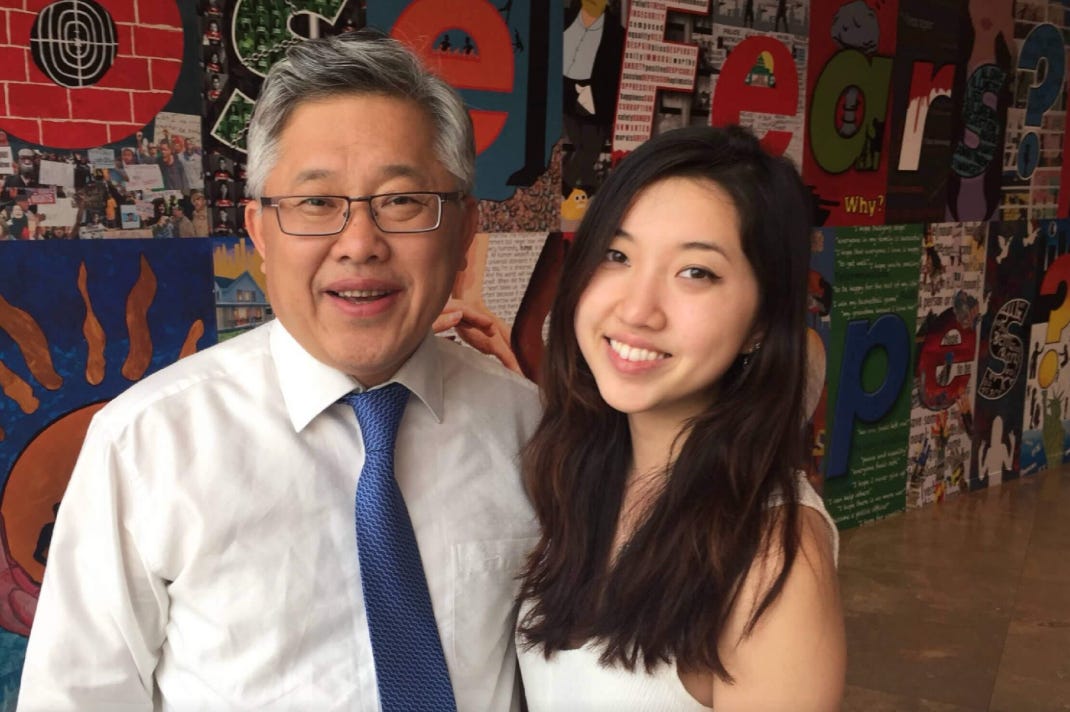
A Chinese Pastor's Daughter Prays Xi Will Soften His Heart and Free Her Father — as Beijing's Intimidation Follows Her to America
WASHINGTON – Grace Jin Drexel’s husband sleeps with a metal bat beside their bed, in Washington, in a neighborhood where the couple is surrounded by friends from the United States government. Her mother, the wife of imprisoned Pastor Ezra Jin, lives near Chicago. Since Grace and her husband went public advocating for the release of Pastor Jin — imprisoned since October because he refused to install facial recognition devices in his fast-growing underground churches in China — Grace’s mother has been harassed by Chinese agents, her car tires slashed in her own garage, and falsely threatened with legal action in the United States.
There is a technical phrase for what is happening to her family, Grace says in an interview with The Bureau ahead of Father’s Day, even as that family prays that President Xi Jinping’s heart might be softened — that her father, who suffers from diabetes in prison, could simply be allowed to leave his ministry in China and be reunited with them in the United States.
Grace’s family in the United States lives in fear for its own safety. The technical term is transnational repression. But the American Constitution, and more deeply their Christian faith, gives them the courage to speak the truth in the face of persecution, she says.
“I just want my father released,” she says. “But from my perspective, I just don’t know what else to do. It is very scary to know that I am just an individual and yet there’s a whole machinery that could potentially not want me to do what I have to do, to get my father released.”
There is also the fear that speaking out could provoke Beijing to respond more harshly still. But praying over the problem, the couple, in their faith, have looked higher.
“We really had to also see this as a way of saying, we are just, we are mere individuals, and ultimately it is the work of God to see how this will play out,” she says. “It’s not as much, like, result-focused per se, which is very hard, because ultimately I do hope and pray that my father would be released.”
In testimony to the Congressional-Executive Commission on China in November, she described how on October 10 her father was arrested along with 28 other leaders of his Zion Church; 17 remain imprisoned with him, several in Beihai, in Guangxi province. It was, she said, the largest takedown of an independent house church in China since the Cultural Revolution — brazen enough to draw support across the American government, including from Secretary of State Marco Rubio.
Zion had grown in a single decade from two families to more than 1,500 members, and that growth became its danger.
Since Xi Jinping took power, Grace testified, the Chinese Communist Party has moved to consolidate ideological control, rewriting the country’s religious regulations in 2016 under the banner of “Sinicizing” religion — less Sinicization, she said, than “Party-fication of religion,” with crosses torn down and portraits of Xi and Mao raised where crucifixes had hung. Zion was targeted in 2018 after its leaders refused to install facial recognition cameras in the sanctuary; police seized the building, and her father was placed under an exit ban that has separated him from his family for more than seven years. A fresh wave of arrests swept the country in 2025, more than 150 Zion members hauled to police stations. Grace closed by asking lawmakers to speak the prisoners’ names aloud.
The man at the center of all this represents a subtle paradox in a nation that rapidly evolved from extreme poverty to great wealth, still leaving many feeling empty.
Pastor Jin was the son of a poor farmer, Grace says, and in the late 1980s he won a place at one of China’s most prestigious universities, in Beijing — an achievement that, in a country then opening to the world and short of educated people, promised him and his family a secure and comfortable future. Then came the spring of 1989. He was not a leader of the Tiananmen Square protests, his daughter says, but he was sympathetic, and he went. When the tanks came on June 4, classmates of his never returned, and no one was permitted to speak of them. His worldview collapsed, Grace says, and in the despair that followed he found Christianity.
“He has never heard that in his life in China, like everything was more calculating and such, but to have a God who sacrifices for you without you asking or without you deserving of that — like just basically shattered everything, all his pride and everything. But with that also came just such love and hope and knowledge.”
He eventually came to the United States, studying at Fuller Theological Seminary in California around 2002. For years he served within China’s state-sanctioned church, but he could not, his daughter says, serve two masters — could not preach freely while wrestling constantly with Communist ideology and the suspicion of Party-aligned church officials. In 2007 he returned to China with his family and founded Zion as an independent church, in a period when civil society, media and religious life still enjoyed real space to breathe. That space, Grace says, has been closing ever since.
When the government shuttered Zion’s premises in 2018, the church did not die. It went online, building a hybrid model that, beyond anyone’s expectation, spread nationwide — 100 new congregations across 40 cities, reaching as many as 10,000 people a day. When COVID-19 arrived and the country shut down, Grace says, Zion was among the only churches already equipped with the infrastructure to keep gathering. The Party noticed, and began regulating the online services too.
For nearly eight months after the October arrests, the family did not know what to do. Grace, who came to the United States at eight and is now an American citizen, emailed and texted anyone who might help. Then, she says, came what felt like a miracle: word that the president knew of her father’s case and intended to raise it at a summit in Beijing. By her account, he did, and the family was told that Xi Jinping is now seriously weighing Pastor Jin’s release.
Stepping back from her father’s case, Grace describes a faith far larger than most in the West imagine. No one can count China’s Christians precisely — the persecution makes honest numbers impossible — but estimates run from 80 million to perhaps 160 million. People come to the church, she says, the way people come to faith everywhere: looking for meaning. Many Chinese once assumed their unhappiness was a function of poverty; now that the country is wealthier, she says, the unhappiness remains, and in the ideological vacuum left by the Cultural Revolution, Christianity has filled a void. The churches do what churches do — marriage counseling, mental health support for the young, food for the marginalized. Her father’s church ran annual blood drives for Beijing’s blood bank until its building was seized.
This, Grace argues, is precisely why the Party fears the house churches — not because they are dangerous, but because they care for society out of love rather than control, model transparent and democratic leadership, and answer to a head other than the state. A self-described atheist organization that seeks to govern everything, she says, cannot abide an institution that claims the most intimate part of a person — belief itself. The facial recognition cameras her father refused were the point: a church that will not let the state watch its worshippers is a church the state cannot own.
Faith, Grace says, is the only thing that has carried her. She knew going in how these cases usually end — that political and religious prisoners in China rarely get a happy ending. Her father, by contrast, has always been an optimist. Before his detention, a fellow pastor asked him what he would do if the entire church were imprisoned. Grace says he answered without hesitation: “hallelujah, the church will grow.”
She has not seen him in person since 2020; her mother and brothers, since 2018. In China, she notes, an exit ban turns the whole country into a kind of prison for those who cannot leave — and her father, even before his arrest, was one of them.
What Pastor Jin — and now his daughter — ask of the West is not to look away.
Stories like Pastor Jin’s imprisonment, she says, can feel distant because people tend to focus on what is directly in front of them. And the temptation — especially toward a country as large and economically formidable as China — is to stay silent in the name of other interests.
She doesn’t name those interests, but others have pointed to the wealth China spreads in exchange for acceptance of the Chinese Communist Party’s policies on, and increasingly beyond, Chinese soil.
Grace frames what she believes her father’s message to the world would be in the language of their shared faith: when one part of the body suffers, the whole body should ache. “How can you look away from that pain,” she asks, “if that is your own family member?”


Again, Mr Carney, I ask what is in the MOU with China? This should scare the hell out of all Canadians. This young lady’s story is no doubt the tip of the iceberg, no one should have to live that way. I also hope and pray for her father’s release we all need to pressure our governments.
Praying for Pastor Jin and the softening of Xi’s heart, that Grace’s father would be released. My prayers are with the family.