

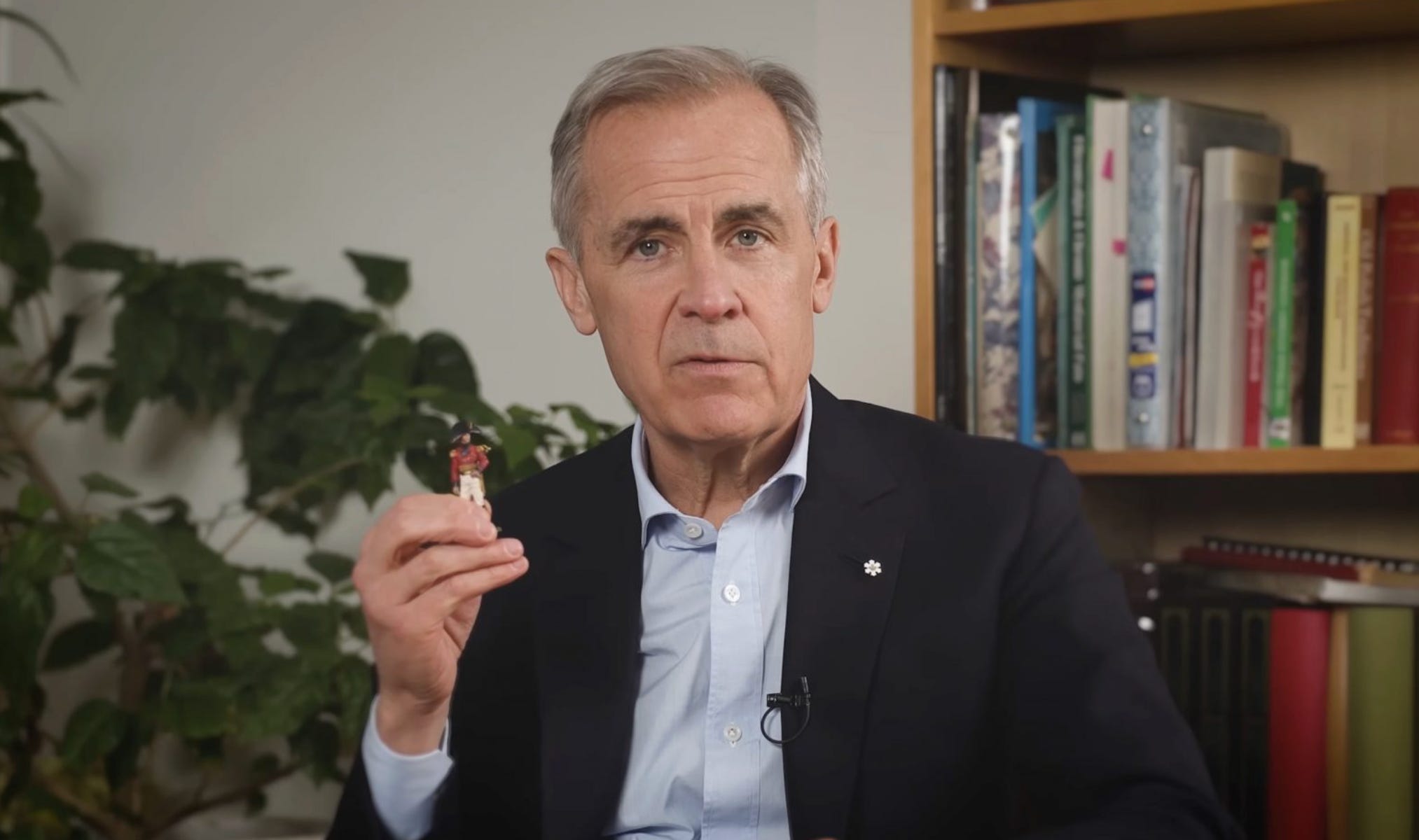
OTTAWA — On May 6, Guangming Daily — not just an official Chinese Communist Party newspaper, but allegedly the favored mouthpiece of the world’s largest intelligence agency — published an admiring essay under a headline that reads “From dependence to autonomy: how the Carney government is reimagining Canada–U.S. relations.” The piece, which approvingly amplified Carney’s odd choice to flourish a figurine of the British general Isaac Brock, famed for repelling an American invasion in 1812, does not report on Prime Minister Mark Carney’s rupture with Washington so much as celebrate it.
It casts his turn away from the United States not as a crisis to be managed but as an awakening to be admired, a passage from servitude to sovereignty.
The striking part is that the essay’s central idea — dependence giving way to autonomy — was, almost to the word, the case Carney himself made to a room of American financiers three weeks later.
At the Economic Club of New York on May 28, the prime minister described Canada’s drive to become “more autonomous” as a “core” objective of his government, then sanded the edge off with a line built for the room: “Let’s be absolutely clear. Canada Strong will help make America great again.”
Strip away the flattery — a borrowing of Donald Trump’s own core slogan — as Guangming Daily does, and the same program remains beneath it: a deliberate loosening of the ties that bind Canada to the United States, even as Carney trumpets forging deeper strategic ties with Beijing in trade, law enforcement, media and culture.
According to the Australian analyst Alex Joske, the China-influence expert who wrote the definitive study of Beijing’s feared Ministry of State Security, Guangming Daily is, in his words, “still the MSS newspaper of choice today.” In Spies and Lies, his account of the ministry’s influence operations, Joske documents its long use of publishing houses, think tanks and newspapers as fronts to shape Western opinion and to reach its agents; among them is the China Institutes of Contemporary International Relations, an organization the ministry knows internally as its Eleventh Bureau. This is the apparatus that has now chosen to lavish praise on a sitting prime minister of a Five Eyes democracy.
The essay’s other enthusiasms are specific.
It praises Carney for resisting what it calls American expansion, and casts Canada, under his hand, as a representative of a world standing against “America first” and economic coercion. It applauds the defense decoupling now underway in Ottawa — the pledge to route the bulk of federal defense contracts to domestic firms, the march toward five percent of output on the military by 2035, the billions promised for the Arctic — and reads each as a healthy loosening of the American grip. And it closes by noting that Canada supplies roughly sixty percent of American crude imports and is Washington’s most reliable source of nickel, while a tariff-burdened Trump administration heads into a midterm election under strain. The subtext is not subtle.
Canada has leverage, Donald Trump is vulnerable, Ottawa can afford to stall.
The Bureau makes no claim that Carney sought, welcomed, or coordinated with this Ministry of State Security endorsement. What the record shows is explicit: the propaganda arm of a hostile intelligence service has decided to celebrate, in flattering and well-informed detail, the foreign policy of an allied head of government.
That trope — Carney as the bulwark against a tariff-obsessed Donald Trump — is not new from Beijing.
It is almost exactly the message a Chinese Communist Party information operation pushed during the 2025 federal election, when Canada’s election-threat monitor, the Security and Intelligence Threats to Elections Task Force, disclosed a covert campaign run through Youli-Youmian, WeChat’s most popular news account, casting Carney as the tough Canadian leader best suited to stand up to Washington — one post titled, in translation, “The United States is Facing a Tough Prime Minister from Canada.” Intelligence tied that account to the Communist Party’s Central Political and Legal Affairs Commission. A year later, the Ministry of State Security’s newspaper of choice tells the same story.
There is a logic to that enthusiasm, and it is known in Ottawa.
Among the durable aims of Chinese statecraft is to divide the Five Eyes — to pry the United States apart from the allies with whom it shares its deepest secrets. A 2018 report published by the Canadian Security Intelligence Service through its academic outreach program mapped the method with unsettling foresight. Trading partners, it warned, “have quickly found that China uses its commercial status and influence networks to advance regime goals.” And it issued a caution that reads today like a note left for the present government: “Unless trade agreements are carefully vetted for national security implications, Beijing will use its commercial position to gain access to businesses, technologies and infrastructure that can be exploited for intelligence objectives, or to potentially compromise a partner’s security.”