200 Foreign Guards, Hezbollah Links, and the Risk a “Major Foreign Power” Could Step In: Inside the U.S. Legal Memo Behind the Maduro Seizure
A newly disclosed legal opinion argues President Trump could deploy military force to back an extraterritorial arrest, while warning of escalation, foreign-backed security.
WASHINGTON — The newly disclosed Office of Legal Counsel memo reads less like a dry legal brief than a heavily redacted special-operations playbook.
In laying out the legal case for the Trump administration’s extraordinary seizure of Nicolás Maduro, the opinion acknowledges the prospect of blowback under international law and the operational risk that a “major foreign power might lend additional support” to his regime — yet concludes the President could lawfully use U.S. military force to support a law-enforcement capture mission.
The memo cites intelligence indicating Maduro was protected by “as many as” 200 foreign state guards, and it describes an alleged narco-trafficking apparatus headed by Maduro and a circle of generals that Washington believed was intertwined with Hezbollah, Iran-linked weapons flows, and Colombia-origin narco-terrorists who fled earlier American crackdowns and took official roles inside Maduro’s security state.
It also suggests that, while the alleged narco-terror and corruption allegations against Maduro were judged significant enough to warrant an extraordinary arrest and high-risk special-forces rendition, there were other “serious” but as yet unfiled accusations — including murder and terror facilitation.
“While we have been advised that Maduro is under investigation for potential charges of material support for terrorism, he has not yet been charged with such offenses as of the time of this memorandum,” the document says.
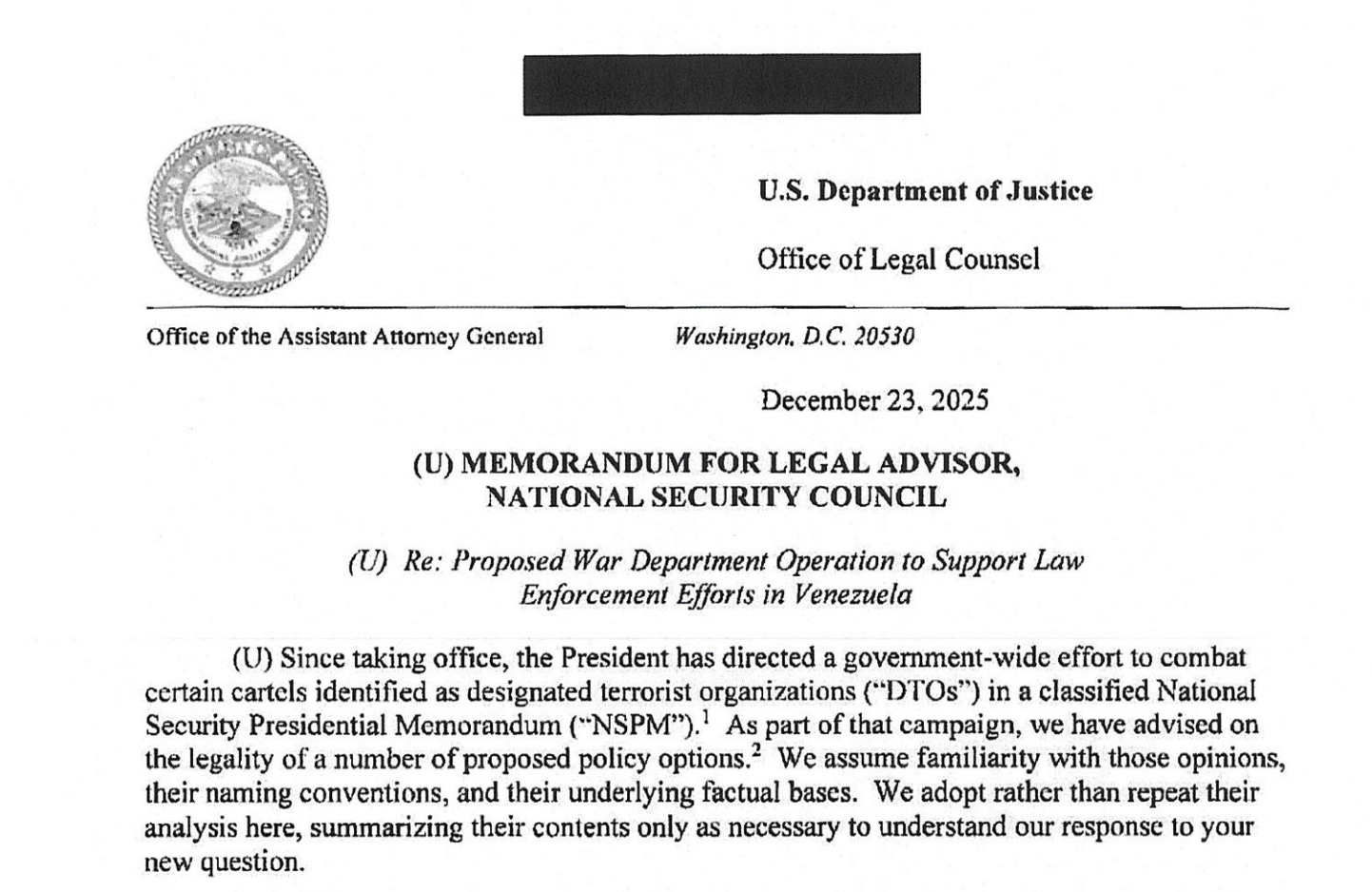
Dated Dec. 23, 2025, and titled “Proposed War Department Operation to Support Law Enforcement Efforts in Venezuela,” the 22-page, partially classified document was written as the Trump administration weighed an action that would look, to much of the world, like an act of war: sending U.S. forces into Venezuela to seize Maduro and bring him to the United States for prosecution.
Much of the memo’s mapping of the military structure U.S. intelligence spent months studying is blacked out. But what remains sharpens the operation’s logic and risk calculus — pointing to a fortified compound reinforced by foreign security support and to close-range U.S. intelligence reporting from inside Maduro’s orbit.
The memo says the War Department advised that Maduro “spends considerable time at Fort Tiuna,” and it anticipates “significant resistance on the approach.” It cites “as many as 75 anti-aircraft battery sites along the approach route to Fort Tiuna,” and warns of weapons “capable of downing the helicopters carrying the assault and retrieval force.”
The opinion notes that Maduro’s wife is “also expected to be present,” adding that she is “known to be more aggressive and combative” than her husband.
In the memo’s opening pages, the government’s lawyers frame the question before laying out facts and opinions. “Since taking office,” they write, “the President has directed a government-wide effort to combat certain cartels identified as designated terrorist organizations in a classified National Security Presidential Memorandum (NSPM).”
Venezuela, the memo continues, has for years been a sanctuary for global narcos.
“A substantial number of the Drug Trafficking Organizations listed in the classified NSPM have found safe haven in the Bolivarian Republic of Venezuela … allowed to flourish under the corrupt leadership of Nicolás Maduro.”
“You have asked whether, consistent with domestic law, the President may lawfully order military personnel to assist law enforcement in forcibly removing Maduro from Venezuela to the United States for prosecution.”
What follows is an argument designed to do two things at once: to make the plan legally defensible as “law enforcement,” and to prepare policymakers for the reality that it would unfold under battlefield conditions — with the risk of spreading conflict across the Western Hemisphere.
The document is drenched in redactions — black bars that erase operational names, numbers, capabilities, and sentences that specify the presence of foreign military and intelligence officials surrounding Maduro.
Yet where the blackout is incomplete, the remaining text offers a startling level of granular details shedding light on Washington’s audacious military success, and the level of legal planning that preceded the successful strike.
The most vivid operational scene-setting appears in the memo’s discussion of the target location.
The War Department, it says, “has advised that Maduro spends considerable time at Fort Tiuna, a fortified location at the southern end of Caracas.”
Then the document tightens further, into what amounts to an intelligence assumption that sheds light on the true structure of the Venezuelan state.
“Here, we were told to assume that there were as many as 200 armed guards in a literal foxhole who have been sent from and armed by another country purely to ensure Maduro’s safety.”
The memo does not identify the country. In the aftermath, Cuban officials said at least 32 Cuban military and intelligence personnel stationed in Venezuela were killed — a disclosure that, alongside the memo’s own emphasis on foreign-supplied protection, has fueled questions about how deeply Cuban services were embedded in Maduro’s protective apparatus, and whether Cuban intelligence forms a broader layer of control and protection in other Latin American states.
The memo, building its case for extraordinary force, describes Maduro not as an ordinary “drug kingpin,” but as a sovereign-backed nexus of transnational crime, and terror-linked logistics.
It traces the story back to Colombia and the long conflict with the Fuerzas Armadas Revolucionarias de Colombia (FARC), and it describes Venezuela’s military corruption as producing a shadow network: the Cartel de los Soles, “a moniker based on the distinctive sunburst insignia of a Venezuelan flag officer’s uniform.”
In the most sensitive surviving passage about narcotics coordination, which is now supported in the superseding indictment against Maduro unsealed after his capture, the memo states that individuals (redacted) “have attended meetings inside Venezuela with high-ranking members of the FARC and members of the Venezuelan government to openly discuss future narcotics shipments.” It adds that while intelligence had “difficulty corroborating reports” that Maduro “personally directs” drug transfers, he has been assessed as the “de facto leader” of the cadre who run the Cartel de los Soles.
Then the memo goes beyond narcotics into terror-linked allegations and arms:
“For example, Hezbollah has reportedly established a base of operations in Venezuela with direct ties to Maduro in order to exploit its illicit narcotics networks to finance terrorism around the globe. … Moreover, the link between Iran and Venezuela is well established, e.g., … including [redacted] shipments of weapons.”
The memo acknowledges a counterargument: “we have not been provided intelligence that the weapons will imminently be used to attack the United States.” But it argues that the President can still consider the existence of such weapons in deciding whether to send law enforcement to arrest Maduro — and therefore whether military support is needed “to protect such law enforcement personnel.”
In a highly redacted passage — one that never names any country beyond the memo’s earlier, unredacted references to Iran and Hezbollah — the Office of Legal Counsel memo suggests that foreign governments tied to the regime have, so far, shown little appetite to intervene in a major way, even as it leaves open the possibility that “a major foreign power” could step in.
“As for Maduro’s allies, to date, they have provided only limited support, but that might change at a [REDACTED] It is entirely possible under the right circumstances that a major foreign power might lend additional support, in order to protect significant investments either they or their nationals have made in the region.”
Geopolitical analysts and U.S. officials have frequently pointed to China and Russia as the outside powers with the deepest strategic and commercial stakes — and the most to lose — inside Venezuela.
Buttressing the case for military force, the memo argues that ordinary law enforcement tools are inadequate for the scale of the threat it describes.
“First, the allegations against Maduro are severe. As we have described at length, [REDACTED] was justified by the necessity to disrupt the ability of DTOs to fund ongoing armed conflict with the U.S. and its allies in the region that is beyond the level at which ordinary law enforcement can effectively respond,” the document says. It continues, “ [REDACTED] Although not charged with homicide, Maduro is factually accused of directly participating—or, at minimum, facilitating—that activity.”
The memo then pivots from the charged conduct to what it calls a broader pattern of high-risk behavior by Maduro’s regime.
“Second, in addition to the severe conduct alleged in the indictment, Maduro and his regime have been assessed as being involved in numerous other highly dangerous activities.”
The memo also invokes a separate, hemispheric-security justification: it references aggressive Venezuelan actions including “buzzing American naval vessels,” “placing troops on the border with Colombia,” and destabilization of neighbors, including Guyana amid a “longstanding and very public boundary dispute.” It says those actions were not assessed as sufficient to justify a military attack on Venezuela — but they are used to justify deference and risk assessment in supporting a law-enforcement capture mission.
The memo also leans on a humanitarian-protection rationale — arguing that force may be necessary not only to execute an arrest, but to protect civilians in Venezuela and abroad from the downstream effects of Maduro’s rule. It notes that presidents have “on many occasions” used military force “to prevent or mitigate humanitarian disasters,” including the mass “displacement of civilians” that can “deepen[] the instability in the region,” citing prior Office of Legal Counsel analysis in the Syrian Chemical Weapons matter.
To ground that humanitarian claim, the memo points to public reporting on Venezuela’s collapse. Citing Human Rights Watch, it notes that in a population of 28.8 million, “over 20 million Venezuelans live in multidimensional poverty with inadequate access to … food and essential medicines,” and that more than 14 million “face severe humanitarian need.” It adds that medicines were “unavailable at 28.4 percent of pharmaceutical dispensaries,” with 5.1 million people facing hunger — conditions the memo links to cascading instability and displacement.
It concludes: “The situation has only deteriorated as Maduro has responded to his electoral loss with a new wave of repression against dissenting voices.” Citing the State Department’s 2024 Human Rights Report, it notes that one NGO documented 361 extrajudicial killings in the first eight months of 2024.
In another partially redacted passage, the memo inserts a blunt caution — “Of course, the enemy gets a vote.” It warns that Maduro’s departure “(whether voluntary or otherwise)” could trigger “mass confusion,” with multiple possible successors spanning his inner circle and the “legitimately elected government,” and “no clear frontrunner.”
A key selling point to the NSC is that even if the operation is an “extrajudicial transfer,” it won’t necessarily block a later U.S. prosecution. The memo notes the practice is still debated publicly, but says all three branches have “accepted” the practice of “extrajudicial transfer of a person from one [country] to another,” and it specifically frames the plan as “extraordinary rendition” while insisting it “would not endanger any subsequent U.S. prosecution.”
The memo also contains a quiet assertion about international law: near its conclusion, it says that even if someone later argued the operation violated international law, “such an argument does not vitiate the President’s authority to order it under longstanding precedent.”
Adding to the aura of American power in the aftermath — and the intelligence underpinning the account of hundreds of foreign guards surrounding Maduro — accounts have emerged online that are not officially confirmed by the White House, but appear to have been treated as at least politically useful by senior Trump aides — including when White House press secretary Karoline Leavitt amplified on X a purported interview with a security guard who claimed to have survived the raid.
“From those helicopters, soldiers came down, but a very small number. Maybe twenty men. But those men were technologically very advanced,” the interviewee states, adding “it seemed like each soldier was firing 300 rounds per minute. We couldn’t do anything.”
The purported security guard added their weapons were useless, as “At one point, they launched something—I don’t know how to describe it... it was like a very intense sound wave. Suddenly I felt like my head was exploding from the inside.”


I have to wonder… “if”…….there was an “interview” with one of the guards protecting Maduro OR is the alleged interview USA propaganda? If it is true…. the USA certainly has one hell of a secret weapon that will scare the hell out of any nation deciding to attack the USA …. or for the USA military to use in any type of combat. “A sonic explosion” that renders people unable to move?
IF this is true…… WHY were so many of Manduo’s guards killed?
Who was it that “interviewed” this alleged “survivor/guard”.
Guards “bleeding” from the head areas”?
Was that the cause of the deaths of the 23 guards? If so…. WHY did the guard that was …………..”allegedly” ..interviewed…… survive to be interviewed…… and such a short time after the capture of Manduro?
Hey…… good for Trump on having the guts to take out this dangerous desperado. GREAT that not one USA military personnel died. What a hell of a successful mission … all around…… but I have trouble believing the secret weapon issue. I HOPE I’m wrong!
This is how an empire runs things. Trump wants communism out of the western hemisphere. It’s a matter of national security to not have countries that can allow China or Russia ports to park submarines or war ships at. Since Maduro’s capture the US has located an Iranian drone manufacturing facility among other finds. This is also putting Cuba is a massive bind as their oil that keeps the lights on there has been cut off. Cuba is most likely who falls next. Why this wasn’t done before is quite baffling. The US seriously allowed a country 90 miles off its shore to be allies with Russia and China. It makes no sense and soon it should be solved. Trump is going to make sure the US is safe and set for what’s inevitable which is war with China. Any country giving safe harbor to China should look at their actions and see if they wish to change course otherwise it’s quite likely you’ll be conquered. There’s not a damn thing anyone can do about it either. Sure they can scream on TV or protest and all for international law to interfere but none of it is any threat really. Once NATO really dies the US can ally with Russia finally and then China can be contained. It’s the only way the west survives.