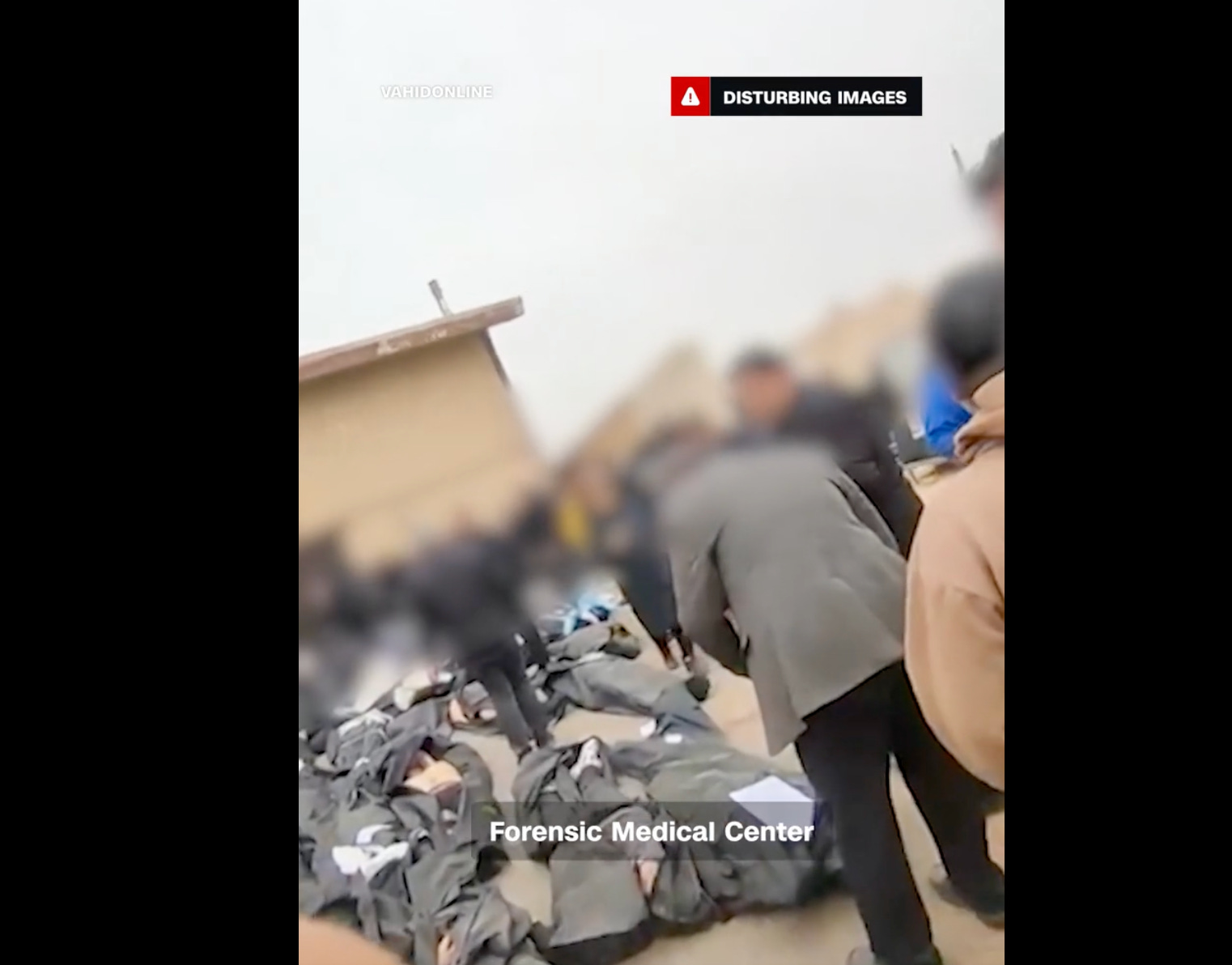
12,000 Dead in Two Nights: Iran International Estimates Mass Killings Under Khamenei as the Internet Blackout Began
A London-based Persian-language outlet long critical of Tehran says its multi-source review points to a coordinated crackdown—an explosive estimate that dwarfs other reported death counts.
WASHINGTON / LONDON — As President Donald Trump reportedly deliberates whether to follow through on his promise to strike Iran if the regime crushes an escalating revolt with mass killings, Iran International reported Tuesday that it now assesses at least 12,000 people were killed — “largely over two consecutive nights, Thursday and Friday” — in what it calls “the largest killing in Iran’s contemporary history.”
The outlet said its editorial board spent days reviewing casualty reports drawn from a broad range of sources, including senior Iranian state officials and data collected from across affected cities. In its statement, Iran International said it delayed publication until “the volume of evidence and the convergence of accounts reached a point where a relatively accurate assessment became possible.”
That estimate far exceeds other international figures but aligns with the timing of a nationwide internet blackout imposed by Tehran on Thursday. Verified videos and reports transmitted through the blackout — reviewed by The Bureau and international media including The New York Times — show corpses and body bags outside hospitals, in many cases surrounded by grieving relatives.
According to Iran International, its multi-stage verification process drew on “a source close to the Supreme National Security Council; two sources in the presidential office; several sources within the Islamic Revolutionary Guard Corps in Mashhad, Kermanshah, and Isfahan; eyewitness and family testimonies; field reports; medical data; and information from doctors and nurses in various cities.”
The outlet said those killed “were mainly shot by forces of the Islamic Revolutionary Guard Corps and the Basij,” describing the operation as “fully organized, not the result of ‘sporadic’ or ‘unplanned’ clashes.” It emphasized that its figure remains an initial assessment and that, under the ongoing communications blackout, “confirming a final figure will require further, detailed documentation.”
The report lands amid sharply divergent death tolls and intensifying alarm over Iran’s communications blackout.
An Iranian official told Reuters that roughly 2,000 people have been killed in two weeks of unrest—an extraordinary acknowledgment, paired with the regime’s insistence that “terrorists” are to blame.
The United Nations human rights office, in parallel, said it has received credible reports of hundreds killed, warning of continuing lethal force, mass detentions, and the potential use of the death penalty against thousands of detainees.
Accurate casualty reporting now carries exceptional weight because it is colliding with high-level deliberations in Washington over how President Donald Trump might respond if Tehran escalates the crackdown further.
Those dynamics echo themes explored in The Bureau’s Friday interview with Negar Mojtahedi of Iran International, where we examined how the blackout was degrading real-time verification, restricting organizing, and enabling harsher repression away from internationally broadcasting cameras.
Mojtahedi also argued that Trump’s warning—if the regime kills its people, America’s military is “locked and loaded”—has shifted the psychological environment for protesters compared with past uprisings during the Islamist regime’s 47-year rule, and that the signal from Washington has inspired a new confidence across many sectors of Iranian society. She said the message lands differently given Trump’s record of kinetic action, including the killing of Qasem Soleimani and precision strikes on nuclear-related targets, as well as the stunning extraction of Iranian regime ally President Nicolás Maduro in Venezuela—a state U.S. intelligence has portrayed as a proxy base of operations and influence for Iran, China, and Russia.
Inside the White House, reporting now centers on a live debate over diplomacy first versus rapid strike readiness. The Wall Street Journal reported that Trump is scheduled to be briefed on a menu of options that includes military strikes, cyber operations, expanded sanctions, and steps to amplify anti-regime messaging online.
In the same reporting stream, senior aides led by Vice President JD Vance have been described as urging a diplomatic channel before strikes, even as the administration keeps force publicly on the table. Secretary of State Marco Rubio, meanwhile, has underscored U.S. support for Iranians amid the crackdown and blackout—messaging that sits alongside the pressure camp’s view that deterrence requires credible strike planning.
The broader geopolitical picture running through that debate is inseparable from oil, sanctions evasion, and Iran’s oil trading lifelines—especially to China. Reuters reporting has described China as buying the vast majority of Iran’s oil exports, often via opaque routing and ship-to-ship transfers designed to blunt U.S. sanctions. That reality helps explain why Trump has moved to widen the cost of doing business with Tehran, including a newly announced 25 percent tariff threat aimed at any nation that continues trading with Iran.
A second theatre is also shaping the energy-and-enforcement chessboard: Venezuela.
The U.S. Treasury has emphasized that Caracas’s sanctions-evasion ecosystem depends on a “shadow fleet” of vessels and facilitators—an architecture Washington has been targeting as it tries to squeeze illicit oil revenue streams. In that wider frame, Iran’s internal crackdown, its external oil lifelines, and Washington’s pressure toolkit are increasingly being read as parts of the same contest—one in which the standoff between Washington and Beijing looms above all, shaped by Beijing’s long-standing insistence that “reunification” with Taiwan must be achieved, with force not ruled out. U.S. experts fear such a move could give China strategic leverage over advanced semiconductor supply chains critical to next-generation technologies, while risking a global economic shock by disrupting the vast volumes of shipping that move through the Taiwan Strait.


The idea that the semiconductor market will be blunted by China taking over Taiwan is just inaccurate. Companies have built new foundries in the US recently and new ones are under construction right now. There might be some slow down but chips are being made right here right now and Trump made manufacturing them in the US a top priority and you can see why.
Tehran killing 12,000 of its own people is disguting. I’ve also read people are set to be hanged within days for protesting. I certainly don’t want boots on the ground but something has to be done. Threats by Iran shouldn’t be taken too seriously as we all saw how weak their response was in Israel. Their tech is old when it comes to missles. Drones would be a different story but I doubt any can reach the US mainland from there. I could be wrong but I don’t think they have the range. Cuba isn’t going to act in defense of Iran. I’d expect the Israeli moussad to have plans in play with BiBi needing Trump to give him the go ahead on them. I’m sorry but 12,000 people cannot die in vain.
This is heartbreaking to hear. Where is our grand "International Order", and those with in the UN? Where is the Human Rights Court of Progressive opinion and their grandized announcements to demean the Iranian Regime?? Nothing but crickets across the paid Corporate and Progressive Media, as people are slaughtered for daring to stand up against tyranny? The entire "Order" is a marooned ideological elite who's aloof group think has them running in circles in order to appease the masters of their own demonic desires. They truly are merely parasites that feed off the very people they are to serve and are as permissive and demonic as the Iranian regime itself. These are the same Global Institutions, who now demand control over democratic country's in order to turn them into bureaucratic controlled regimes, under duress from"climate change". Meanwhile they are busy attacking the only democratic country's that actually stand up against tyranny and who truly protects the people with in their borders. The entire International Order is getting more and more difficult to stomach, as they seem to encourage the breakdown of humanity in all its forms, while demonizing those who prefer action against tyranny. Where is our leader? On his way to China, the biggest human rights abuser of all, as he deems the US the enemy.